


Introduction: Expanding the Visual and Operational Field
Event production has traditionally relied on fixed cameras, handheld rigs, and crane systems to capture and broadcast experiences. While these tools have evolved significantly, they remain constrained by physical positioning, operator limitations, and predefined coverage zones. As events grow in scale and complexity, these constraints limit both creative expression and operational visibility.
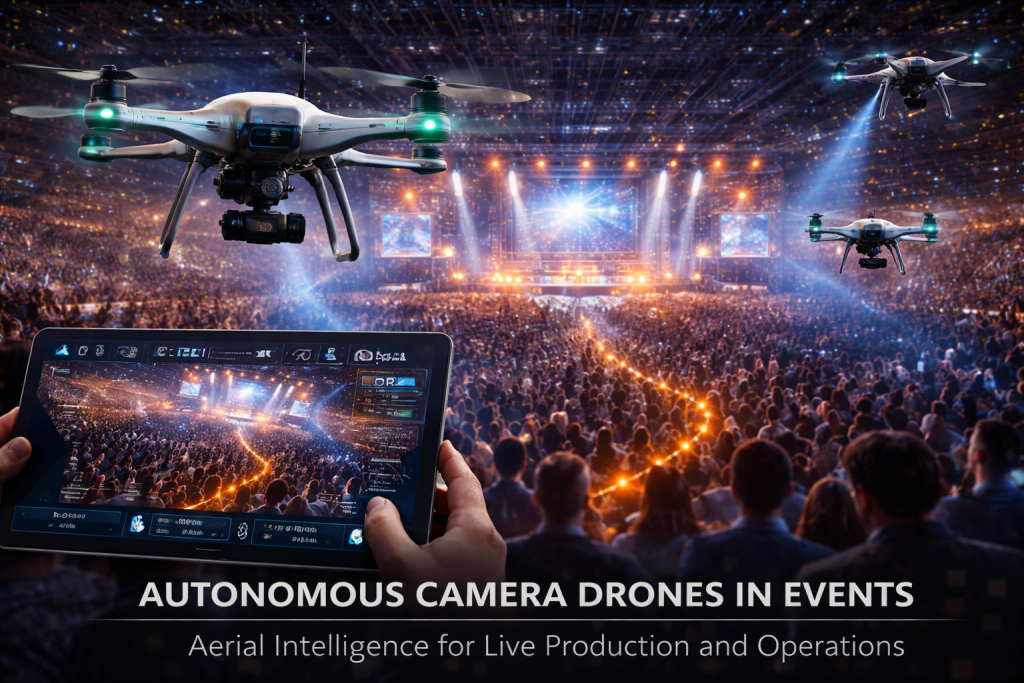
Autonomous camera drones introduce a new dimension. By combining aerial mobility with onboard intelligence, drones can capture dynamic perspectives, monitor environments in real time, and integrate directly into event systems. More importantly, when augmented with AI, they transition from being remotely controlled devices to semi-autonomous or fully autonomous agents capable of decision-making.
In modern event ecosystems, camera drones are no longer just production tools; they are part of a broader sensing and orchestration infrastructure.
From Aerial Cameras to Intelligent Agents
Early use of drones in events focused primarily on aerial videography—capturing sweeping shots of venues, crowds, and performances. These deployments required skilled operators and were often limited to pre-planned flight paths.
The introduction of onboard sensors, computer vision, and edge processing has transformed drones into intelligent systems. They can now:
- Track subjects automatically
- Avoid obstacles in dynamic environments
- Adjust framing based on context
- Coordinate with other devices and systems
This evolution enables drones to operate with increasing autonomy, reducing reliance on manual control and enabling more complex use cases.
System Architecture: Sensing, Processing, and Control
Autonomous camera drones operate as distributed systems, combining hardware and software components that work together in real time.
Onboard Sensing
Drones are equipped with multiple sensors that provide situational awareness:
- High-resolution cameras for visual capture
- Depth sensors and LiDAR for obstacle detection
- GPS and inertial measurement units (IMUs) for positioning
- Ultrasonic sensors for close-range navigation
These sensors generate continuous streams of data that inform navigation and decision-making.
Edge Processing and Computer Vision
Onboard processors analyze sensor data in real time. Computer vision models enable capabilities such as:
- Object detection and tracking (e.g., speakers, performers, crowds)
- Scene understanding and classification
- Gesture and motion recognition
Processing at the edge reduces latency and allows drones to respond तुरंत to environmental changes.
Flight Control and Navigation
Autonomous navigation systems integrate sensor inputs with control algorithms to manage flight paths. These systems handle:
- Path planning and optimization
- Collision avoidance
- Stabilization and positioning
Advanced implementations use simultaneous localization and mapping (SLAM) to navigate complex indoor environments where GPS signals may be unreliable.
Communication and Coordination
Drones communicate with ground systems and other devices through wireless networks. This enables:
- Real-time video transmission
- Coordination with other drones or cameras
- Integration with event control systems
Low-latency communication is essential for synchronization with live production workflows.
Integration with Event Production Systems
Autonomous camera drones are increasingly integrated into professional production environments. They function as mobile camera units that can adapt dynamically to changing conditions.
In live broadcasting, drones can automatically adjust framing based on stage activity, ensuring optimal coverage without manual intervention. They can track speakers as they move, capture audience reactions, and transition between perspectives seamlessly.
Integration with production control systems allows drones to be treated as part of a coordinated camera network. Directors can define high-level objectives—such as focusing on a specific subject or area—while the drone handles execution.
This approach reduces operational complexity while expanding creative possibilities.
Operational Applications Beyond Videography
The value of autonomous drones extends beyond content capture. Their ability to provide real-time aerial intelligence makes them useful for operational management.
In crowd monitoring, drones can provide overhead views that reveal movement patterns and density توزيع. Computer vision models can analyze these patterns to detect congestion or anomalies, enabling proactive interventions.
For security, drones can patrol large areas, monitor restricted zones, and respond to incidents بسرعة. Their mobility allows them to cover areas that are difficult to monitor باستخدام fixed infrastructure.
In logistics, drones can assist with tasks such as equipment inspection or coordination across large venues. While still emerging, these applications highlight the broader role of drones as operational assets.
Experience Enhancement and Audience Engagement
From an attendee perspective, drones contribute to more immersive and dynamic experiences. Aerial footage enhances live displays and broadcasts, providing perspectives that would otherwise be inaccessible.
In interactive scenarios, drones can become part of the experience itself. Coordinated drone displays, synchronized with lighting and audio, can create visually compelling performances. While distinct from camera drones, these applications share underlying technologies and infrastructure.
The integration of drones with real-time personalization systems also opens new possibilities. For example, drones could capture and deliver personalized content to attendees, tailored to their location and interests.
Safety, Regulation, and Risk Management
The deployment of autonomous drones in events introduces significant safety considerations. Operating in environments with large crowds requires strict adherence to safety protocols and regulatory requirements.
Collision avoidance systems, geofencing, and fail-safe mechanisms are essential to prevent accidents. Redundant systems ensure that drones can respond safely to failures or unexpected conditions.
Regulatory frameworks vary by region, governing aspects such as flight permissions, altitude limits, and operator certification. Event organizers must navigate these regulations carefully to ensure compliance.
Risk management also includes contingency planning. Systems must be designed to handle disruptions without impacting overall event operations.
Technical Challenges
Despite their capabilities, autonomous camera drones face several technical challenges.
Indoor navigation remains complex due to limited GPS availability. While SLAM and other techniques provide solutions, they require precise calibration and can be sensitive to environmental conditions.
Battery life محدود flight duration, necessitating careful planning or the use of multiple drones to maintain continuous coverage.
Environmental factors, such as lighting conditions and obstacles, can affect sensor performance and model accuracy.
Integration with existing systems adds another layer of complexity, requiring robust APIs and synchronization mechanisms.
Future Outlook: Swarm Intelligence and Fully Autonomous Capture
The future of camera drones in events is likely to involve greater autonomy and coordination. Swarm intelligence—where multiple drones operate collaboratively—can enable more sophisticated coverage and redundancy.
Advances in AI will further enhance capabilities, enabling drones to understand context at a higher level and make more nuanced decisions. Instead of following predefined rules, they will adapt to unfolding scenarios in real time.
Improvements in battery technology, sensor systems, and network infrastructure will expand operational possibilities, making drones more reliable and accessible.
Integration with broader event intelligence systems will position drones as key components of a unified sensing and orchestration layer.
Conclusion: Aerial Systems as Event Infrastructure
Autonomous camera drones represent a convergence of robotics, AI, and event technology. They extend the visual and operational capabilities of events, enabling new forms of content capture, monitoring, and interaction.
Their role is evolving from specialized tools to integral components of event infrastructure. As systems become more autonomous and interconnected, drones will contribute not only to how events are seen, but also to how they are managed.
For event technology leaders, the challenge lies in integrating these systems effectively—balancing innovation with safety, creativity with control, and autonomy with oversight.