


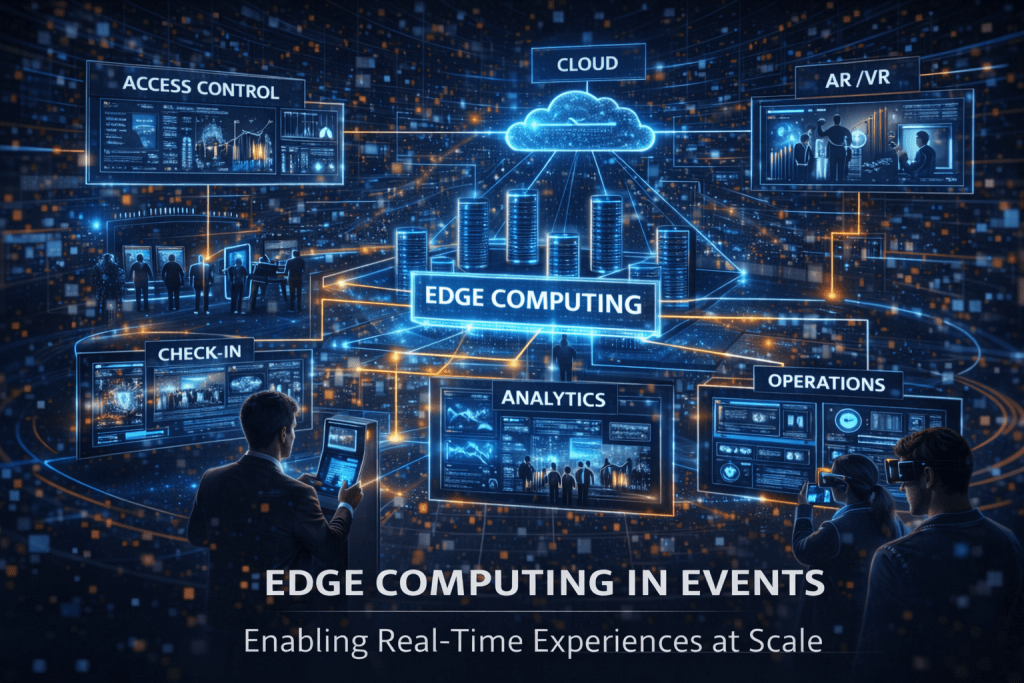
Introduction: The Latency Problem in Modern Event Environments
Table of Contents
ToggleAs events become increasingly interactive and data-driven, the demand for real-time responsiveness has intensified. Attendees expect instant check-ins, seamless navigation, live personalization, and uninterrupted digital experiences. Behind the scenes, organizers must coordinate logistics, monitor crowd dynamics, and respond to changing conditions with minimal delay.
Traditional cloud-centric architectures struggle to meet these expectations. While cloud platforms provide scalability and centralized processing, they introduce latency due to network round trips, bandwidth constraints, and dependency on stable connectivity. In high-density event environments—such as large conferences, exhibitions, or stadium-scale gatherings—these limitations become operational bottlenecks.
Edge computing addresses this challenge by moving computation closer to where data is generated. In the context of events, this means processing data at or near the venue itself, enabling faster decision-making, reduced latency, and greater system resilience.
Understanding Edge Computing in the Event Context
Edge computing refers to a distributed computing model where data processing occurs at the “edge” of the network, rather than in centralized cloud data centers. In event environments, the edge can include:
- On-site servers or micro data centers
- Smart gateways connected to IoT devices
- Network edge nodes integrated with venue infrastructure
The goal is to minimize the distance between data generation and processing. Instead of sending every data point to the cloud, edge systems handle time-sensitive operations locally while selectively synchronizing with centralized systems.
This hybrid model—combining edge and cloud capabilities—forms the foundation for real-time event experiences.
The Nature of Real-Time Event Workloads
Event environments generate a unique class of workloads characterized by high concurrency, temporal sensitivity, and spatial variability. These workloads include attendee check-ins, badge scans, movement tracking, session participation, and interactive engagement.
What makes these workloads challenging is not just their volume, but their need for immediate processing. A delay of even a few seconds can disrupt entry flows, degrade user experience, or lead to operational inefficiencies.
Edge computing is particularly suited to these conditions because it allows critical operations to be executed locally, without relying on external network conditions.
Architectural Model: Edge-Cloud Hybrid Systems
An effective edge computing strategy for events is not about replacing the cloud, but augmenting it. The architecture typically consists of three coordinated layers.
At the edge layer, local compute nodes handle real-time processing tasks. These nodes are deployed within or near the venue and are responsible for low-latency operations such as authentication, access control, and immediate analytics.
The cloud layer provides centralized processing, long-term storage, and advanced analytics. It aggregates data from multiple edge nodes, supports machine learning models, and enables cross-event insights.
Between these layers lies a synchronization mechanism that ensures consistency. Data processed at the edge is selectively transmitted to the cloud, while updates from the cloud—such as model parameters or configuration changes—are propagated back to edge nodes.
This architecture balances responsiveness with scalability, ensuring that each layer performs the tasks it is best suited for.
Key Use Cases in Event Environments
One of the most visible applications of edge computing is in access control and check-in systems. During peak entry periods, thousands of attendees may attempt to enter simultaneously. Relying on cloud-based verification can introduce delays and create bottlenecks. By processing authentication locally—validating tickets, credentials, or tokens at the edge—entry systems can operate with near-instant responsiveness, even in low-connectivity conditions.
Crowd management is another domain where edge computing delivers significant value. Sensors distributed across the venue generate continuous data on attendee movement and density. Processing this data locally enables real-time detection of congestion patterns and immediate interventions, such as rerouting flows or adjusting access points. The ability to act within seconds can improve both safety and attendee experience.
Interactive experiences, particularly those involving augmented reality or live personalization, also benefit from edge processing. These applications require rapid data processing and rendering, which can be hindered by network latency if handled exclusively in the cloud. Edge nodes can perform initial computations, ensuring smooth and responsive interactions.
Streaming and content delivery represent another critical use case. By leveraging edge nodes as local distribution points, events can reduce bandwidth usage and improve streaming quality. Content can be cached and delivered from within the venue, minimizing reliance on external networks.
Integration with IoT and Venue Infrastructure
Edge computing becomes particularly powerful when integrated with IoT systems embedded within event venues. Devices such as RFID readers, BLE beacons, cameras, and environmental sensors continuously generate data that reflects the state of the event environment.
Edge nodes act as aggregation and processing hubs for these devices. Instead of transmitting raw data to the cloud, edge systems can filter, preprocess, and analyze inputs locally. For example, video feeds can be processed using computer vision models at the edge to estimate crowd density, eliminating the need to transmit large volumes of video data.
This integration reduces bandwidth requirements while enabling faster insights. It also allows for more granular control over how data is processed and used, which is particularly important for privacy-sensitive applications.
Operational Advantages
The primary advantage of edge computing in events is reduced latency. By processing data closer to its source, systems can respond in real time, improving both operational efficiency and user experience.
Reliability is another key benefit. Event environments often face connectivity challenges, particularly in large venues or outdoor settings. Edge systems can continue operating even when cloud connectivity is intermittent, ensuring that critical functions such as access control and safety monitoring remain unaffected.
Scalability is enhanced through distribution. Instead of relying on a single centralized system, workloads are distributed across multiple edge nodes. This reduces the risk of bottlenecks and allows the system to handle high volumes of concurrent activity.
From a cost perspective, edge computing can optimize bandwidth usage by reducing the amount of data transmitted to the cloud. This is particularly relevant for data-intensive applications such as video processing and real-time analytics.
Challenges and Design Considerations
Despite its advantages, edge computing introduces new complexities. Managing a distributed infrastructure requires careful coordination. Edge nodes must be deployed, monitored, and maintained across multiple locations, often under varying environmental conditions.
Consistency between edge and cloud systems is another challenge. Data processed locally must eventually be synchronized with centralized systems, requiring robust mechanisms to handle conflicts and ensure accuracy.
Security considerations are amplified in edge environments. Each edge node represents a potential attack surface, and securing these nodes requires strong authentication, encryption, and monitoring practices.
There is also the question of workload distribution. Determining which tasks should be handled at the edge versus the cloud requires a nuanced understanding of latency requirements, computational complexity, and resource constraints.
Future Directions: Toward Intelligent Edge Systems
The evolution of edge computing in events is closely tied to advancements in AI and network infrastructure. As machine learning models become more efficient, they can be deployed directly on edge devices, enabling local inference without reliance on cloud resources.
This opens the door to more sophisticated applications, such as real-time behavioral analysis, predictive crowd management, and autonomous operational decision-making at the edge.
The rollout of advanced network technologies, including 5G, will further enhance edge capabilities by providing high-bandwidth, low-latency connectivity. This will enable more seamless integration between edge and cloud systems, as well as support for emerging applications such as immersive experiences and spatial computing.
Conclusion: Bringing Intelligence Closer to the Experience
Edge computing represents a critical shift in how event technology systems are designed and operated. By relocating computation closer to the point of interaction, it enables the real-time responsiveness that modern events demand.
Rather than replacing the cloud, edge computing complements it, creating a distributed architecture that balances speed, scalability, and resilience. For event organizers, this approach unlocks new possibilities for delivering seamless, interactive, and adaptive experiences.
As events continue to evolve into complex, data-driven environments, the ability to process information at the edge will become not just an advantage, but a necessity.