


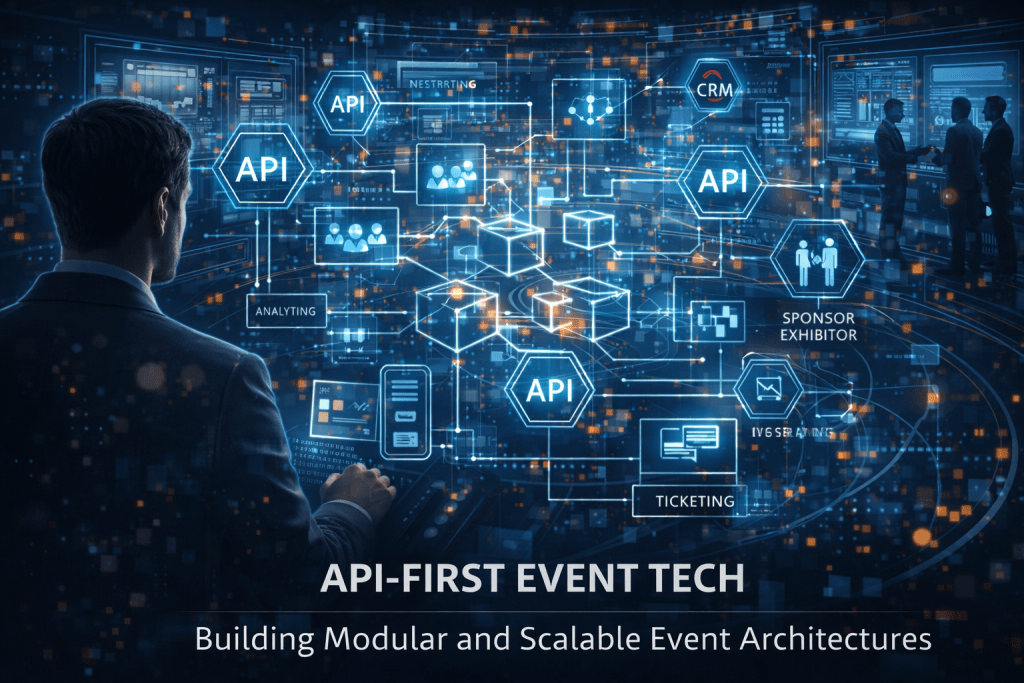
Introduction: From Monolithic Platforms to Composable Event Ecosystems
Event technology stacks have traditionally evolved as monolithic platforms—single vendors offering bundled capabilities such as registration, agenda management, networking, and analytics. While this approach simplifies procurement, it creates structural limitations: inflexible workflows, constrained integrations, and slow innovation cycles.
As event programs scale across geographies, formats, and audiences, organizations are increasingly adopting an API-first approach. In this model, event systems are designed as modular, interoperable components connected through well-defined APIs. Rather than relying on a single platform, organizers assemble best-of-breed services into a composable architecture tailored to their needs.
API-first event tech is not just an integration strategy; it is a foundational design principle that enables scalability, adaptability, and long-term resilience.
What Does API-First Mean in Event Technology?
An API-first approach prioritizes the design and development of application programming interfaces (APIs) before building user-facing applications. This ensures that all system capabilities are accessible programmatically and can be integrated across different platforms.
Key characteristics include:
-
Decoupled services: Each function (registration, ticketing, engagement) operates independently
-
Standardized interfaces: APIs expose consistent, well-documented endpoints
-
Interoperability: Systems can communicate seamlessly regardless of vendor
-
Extensibility: New services can be added without disrupting existing workflows
In an event context, this enables a shift from rigid platforms to flexible ecosystems.
Core Architectural Principles
1. Microservices-Based Design
Instead of a single monolithic application, API-first event platforms are composed of microservices:
-
Registration service
-
Payment service
-
Agenda and content service
-
Networking and matchmaking service
-
Analytics service
Each microservice:
-
Has its own database and logic
-
Communicates via APIs or message brokers
-
Can be developed, deployed, and scaled independently
This architecture reduces system coupling and improves fault isolation.
2. Event-Driven Architecture (EDA)
Event-driven systems respond to real-time triggers:
-
“User registered”
-
“Session started”
-
“Attendee entered venue”
These events are published to a message broker and consumed by other services.
Benefits include:
-
Real-time responsiveness
-
Loose coupling between services
-
Scalability across distributed systems
EDA is particularly important for live events where timing and coordination are critical.
3. API Gateway and Management Layer
An API gateway acts as the entry point for all external and internal requests:
-
Routing requests to appropriate services
-
Handling authentication and authorization
-
Rate limiting and traffic management
API management platforms also provide:
-
Developer portals
-
Usage analytics
-
Version control
4. Data Layer and Synchronization
In a modular architecture, data is distributed across services. Synchronization strategies include:
-
Event streaming for real-time updates
-
Data replication for consistency
-
Unified data models for interoperability
A central data warehouse or lake is often used for analytics and reporting.
5. Identity and Access Management (IAM)
With multiple services and integrations, identity management becomes critical:
-
Single sign-on (SSO) across platforms
-
OAuth2/OpenID Connect for secure API access
-
Role-based access control (RBAC)
IAM ensures a seamless and secure user experience.
Key Components in an API-First Event Stack
Registration and Ticketing APIs
-
Attendee onboarding
-
Ticket issuance and validation
-
Integration with payment gateways
Engagement and Experience APIs
-
Session management
-
Live streaming integration
-
Networking and matchmaking
Sponsor and Exhibitor APIs
-
Lead capture
-
Content delivery
-
Interaction tracking
Analytics and Reporting APIs
-
Real-time dashboards
-
Behavioral data collection
-
Export to BI tools
Integration APIs
-
CRM systems (e.g., Salesforce-like platforms)
-
Marketing automation tools
-
External content providers
Real-World Implementation Scenarios
Multi-Event Portfolio Management
Organizations running multiple events can:
-
Reuse core services across events
-
Customize front-end experiences per event
-
Maintain centralized data and analytics
Hybrid Event Integration
API-first architectures enable seamless integration between:
-
Physical event systems (badging, access control)
-
Virtual platforms (streaming, networking)
This creates a unified attendee experience.
Custom Attendee Experiences
Front-end applications (mobile apps, web portals) can be:
-
Fully customized
-
Built independently of backend services
-
Continuously updated without affecting core systems
Third-Party Ecosystem Expansion
Organizers can integrate:
-
Specialized vendors (AI matchmaking, translation services)
-
Regional service providers
-
Emerging technologies without platform lock-in
Operational and Business Impact
Flexibility and Customization
API-first architectures allow:
-
Tailored workflows
-
Rapid feature deployment
-
Adaptation to different event formats
Scalability
Services can scale independently based on demand:
-
Registration spikes
-
Live streaming loads
-
Real-time analytics processing
Vendor Independence
Organizations are not locked into a single vendor:
-
Easier to replace or upgrade components
-
Reduced long-term risk
Faster Innovation Cycles
Teams can:
-
Deploy updates independently
-
Experiment with new features
-
Iterate quickly based on feedback
Challenges and Considerations
Integration Complexity
While APIs enable flexibility, they also introduce:
-
Increased system complexity
-
Dependency management challenges
-
Need for robust orchestration
Governance and Standardization
Without proper governance:
-
APIs may become inconsistent
-
Documentation may be incomplete
-
Integration efforts may slow down
Security Risks
Exposed APIs increase the attack surface:
-
Authentication vulnerabilities
-
Data breaches
-
Unauthorized access
Strong security practices are essential.
Data Consistency
Distributed systems can lead to:
-
Data synchronization issues
-
Eventual consistency challenges
-
Conflicting data states
Skill Requirements
API-first architectures require:
-
Skilled developers and architects
-
DevOps capabilities
-
Understanding of distributed systems
Future Trends
Composable Event Platforms
The industry is moving toward:
-
Fully modular event ecosystems
-
Plug-and-play services
-
Marketplace-driven integrations
GraphQL and Flexible Data Access
GraphQL adoption will enable:
-
More efficient data querying
-
Reduced over-fetching
-
Better developer experience
AI-Driven Orchestration
AI will increasingly manage:
-
Workflow automation
-
Service orchestration
-
Predictive scaling
Standardization of Event APIs
Industry standards may emerge for:
-
Data schemas
-
API protocols
-
Integration frameworks
Conclusion: Building for Flexibility and Scale
API-first event technology represents a shift from rigid, monolithic systems to flexible, composable architectures. It enables organizations to build event ecosystems that are scalable, adaptable, and future-ready.
However, this approach requires careful planning, strong governance, and technical expertise. The benefits—flexibility, innovation, and resilience—are significant, but they come with increased complexity.
For event technology leaders, the goal is not simply to adopt APIs, but to design systems where APIs are the foundation. In doing so, they can create event infrastructures that evolve alongside changing requirements, emerging technologies, and growing audience expectations.