


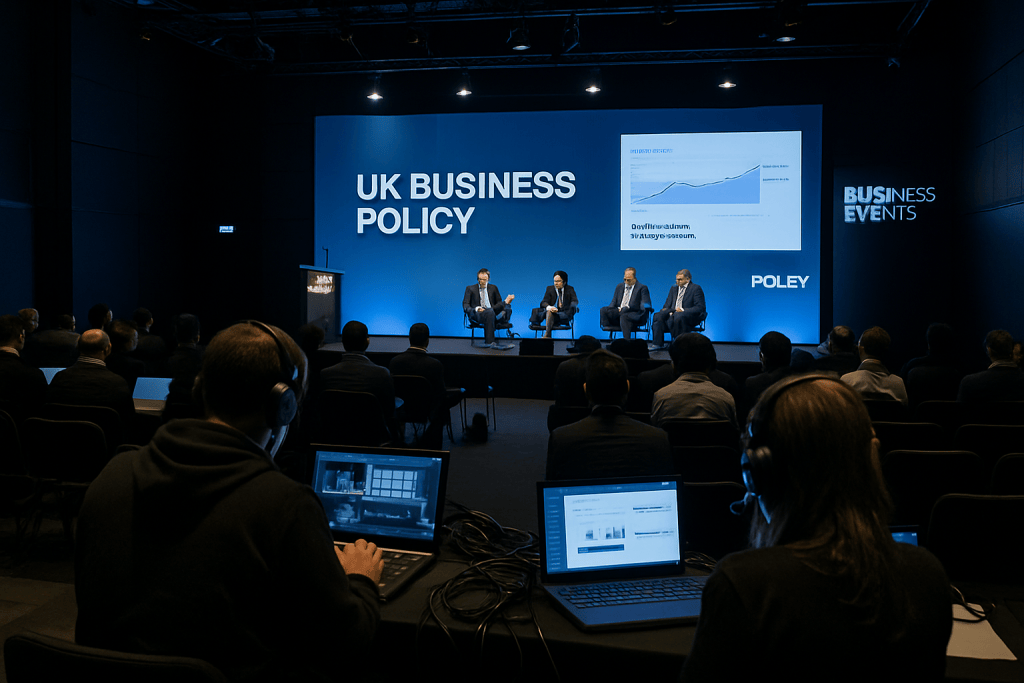
The UK government has issued its formal response to the Culture, Media & Sport (CMS) Committee’s recent report on business events, setting out its position on how the sector will be supported and developed. The response addresses recommendations made in the Committee’s inquiry, which explored the current state and strategic potential of business events within the UK economy.
The Committee’s original report, published in July, collated evidence from a range of industry stakeholders, including event organisers, destination representatives and advocacy bodies such as The Business of Events. The newly released government document reflects how ministers interpret those findings and which policy areas they intend to prioritise.
Background and industry context
Business events – including conferences, exhibitions, meetings and incentive travel – play a significant role in the UK’s visitor economy and wider commercial activity. The sector contributes to regional development, supports knowledge exchange, and generates trade and investment opportunities across multiple industries such as technology, life sciences and manufacturing.
Over recent years, the sector has faced considerable disruption, first from the Covid-19 pandemic and then from ongoing economic and geopolitical uncertainty. These pressures prompted renewed calls for government-backed strategies to support recovery, enhance international competitiveness and recognise business events as a key pillar of the UK’s cultural and economic landscape.
The CMS Committee launched its inquiry into business events to assess how effectively policy, regulation and public investment align with these ambitions. Stakeholders presented evidence on issues such as international competitiveness, skills, infrastructure, sustainability, and the impact of shifting business travel patterns.
Key developments in the government response
The government’s newly published document responds point by point to the Committee’s recommendations, setting out where it agrees, where it partially agrees, and where it does not plan to make changes at this time. While the detailed response is contained in the full text, several themes are evident across the government’s position.
First, the response acknowledges the economic and strategic importance of business events, referencing their role in attracting inward investment, showcasing UK innovation, and supporting regional growth. It reiterates that business events form part of broader tourism, culture and economic development policy, even if they cut across multiple government departments.
Second, the government sets out how existing initiatives and structures are intended to support the sector. This includes references to cross-departmental collaboration, engagement with industry advisory groups, and activity led by national and regional tourism and investment agencies. The response indicates that the government sees these mechanisms as the primary channels for ongoing dialogue and policy development with the events industry.
Third, the document addresses requests for more formal recognition of business events in government strategy. While the Committee advocated for clearer positioning of business events as a strategic priority, the response emphasises that support is often delivered through wider programmes on trade, innovation, skills and place-based growth, rather than through a single, standalone business events policy.
Finally, the government comments on recommendations related to data, research and performance measurement. The response notes current work to improve evidence around tourism and events, and signals an interest in better understanding the value and impact of business events, while stopping short of committing to all of the specific data initiatives proposed by the Committee.
Industry impact and sector reaction
The publication of the response gives event professionals, venues, destinations and technology providers a clearer view of how government currently frames the role of business events. For organisations that contributed evidence to the Committee’s inquiry, the document provides a formal record of how their submissions have been considered at policy level.
While detailed industry reaction will likely evolve as stakeholders analyse the text, the response is expected to prompt renewed discussion on whether existing structures are sufficient to address the sector’s ambitions. Advocacy bodies that fed into the Committee’s work, including The Business of Events, are anticipated to review the response closely and may continue to press for more targeted measures.
The response will also inform how local and regional agencies align their event strategies with national priorities. Cities and destinations competing for international conferences and exhibitions will be watching for any signals about support for bids, infrastructure investment, skills programmes or sustainability initiatives that could strengthen their proposition.
Why this matters for event professionals and technology providers
For organisers, venues and event technology suppliers, the government’s position helps frame the environment in which strategic decisions are made over the coming years.
- Strategic planning: Understanding the extent of national support for business events can inform long-term investment decisions in venues, digital platforms and hybrid capabilities. If government support is largely channelled through broader innovation and regional growth programmes, businesses may need to align proposals more explicitly with these agendas.
- International competitiveness: As other countries position business events as a driver of trade and soft power, clarity on UK policy will influence how competitive the market appears to international associations and corporate planners. Technology providers serving global clients will be assessing whether the UK remains an attractive hub for flagship conferences and exhibitions.
- Hybrid and digital innovation: Evidence presented to the Committee highlighted the growing importance of digital tools, data and hybrid formats. The government’s response, and any follow-on initiatives, could shape support for innovation in areas such as virtual platforms, attendee analytics, accessibility and sustainability-focused technologies.
- Regional growth and skills: Many business events are hosted outside London and the South East, so any emphasis on regional development is relevant for local venues and suppliers. Providers of event technology and services in regional markets may find opportunities to align with initiatives aimed at skills development, digital adoption and destination competitiveness.
In parallel, the government’s attention to measurement and evaluation is likely to place greater emphasis on robust data from organisers and venues. Technology that can reliably quantify economic impact, delegate behaviour and legacy outcomes will be well positioned to support both industry advocacy and policymaking.
Conclusion
The release of the UK government’s response to the CMS Committee’s report on business events marks a key moment in the ongoing dialogue between policymakers and the events sector. While it does not introduce a new, standalone strategy, it clarifies how existing policy frameworks are expected to support business events and where government priorities currently lie.
For event professionals and technology providers, the document serves as a reference point for aligning business plans, investment decisions and advocacy efforts with the government’s stated direction. As industry bodies and stakeholders examine the response in detail, further debate and engagement are likely, shaping how the UK positions its business events offer in an increasingly competitive global market.