


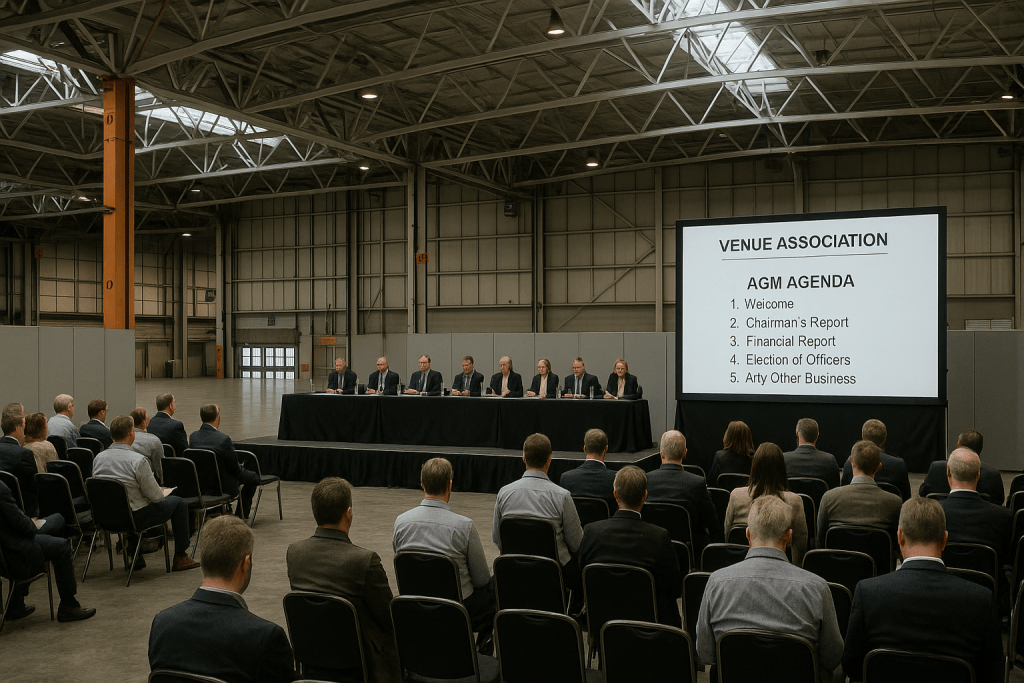
The Association of Event Venues (AEV) has confirmed a series of changes to its board leadership following its annual general meeting (AGM), held at The NEC Birmingham on Thursday, 17 September 2026. The updates mark a new phase of governance for the UK venue body as it continues to support members navigating shifting market, technology and regulatory demands.
At the AGM, outgoing AEV chair Ian Taylor, chief operating officer of the NEC Group, provided an overview of the association’s activities and work over the previous year, noting that the organisation is in a strong position as it transitions to new board leadership.
Background and industry context
The AEV represents a broad cross-section of arenas, exhibition and conference venues, and large event facilities across the UK and beyond. Its work typically covers standards, safety, operations, technology adoption and collaboration across the wider event ecosystem, including organisers, suppliers and partner associations.
The 2026 AGM took place at a time when venues are continuing to adapt to evolving expectations around sustainability, digital services, data-driven operations and hybrid event formats. As venues balance in-person event delivery with the need for resilient digital infrastructure and smarter use of data and automation, sector bodies such as the AEV are playing a more prominent role in guiding best practice and advocating for members.
Leadership continuity and effective governance are therefore increasingly important for venue operators who rely on association networks to share operational insight, benchmark performance and address common challenges, from staffing and supply chain pressures to changing audience behaviour.
Key developments and board update
During the AGM at The NEC Birmingham, AEV members received an update on the organisation’s performance, membership engagement and working group activity. Outgoing chair Ian Taylor outlined the association’s recent projects, including collaborative initiatives across venue safety, operational standards and industry alignment, before formally handing over responsibilities as chair.
Taylor’s update indicated that the association remains in a healthy position, underpinned by active member participation and a programme of working groups and committees focused on day-to-day venue challenges as well as long-term strategic issues. The board changes confirmed at the AGM are intended to build on this foundation, although full details of new appointments and roles were not disclosed beyond the association’s confirmation that a refreshed leadership structure is now in place.
The changes follow the AEV’s usual governance cycle, in which board roles are periodically reviewed and subject to re-election or rotation. This process is designed to ensure a mix of continuity and fresh perspectives from across different venue types and regions, reflecting the diversity of the association’s membership base.
Industry impact and governance implications
While leadership changes within a trade body may appear procedural, they have implications for how sector priorities are framed and advanced over the coming years. The AEV’s board plays a central role in shaping its policy positions, steering working groups and liaising with partner organisations across the wider event and exhibition ecosystem.
For venue operators and their technology partners, stable and active association leadership can influence the pace at which best practices are developed and adopted in areas such as:
- Digital infrastructure and connectivity for events and exhibitions
- Venue safety, crowd management and compliance standards
- Data governance and privacy in relation to visitor and exhibitor data
- Sustainability, energy use and resource efficiency across venue operations
- Integration of hybrid and virtual event capabilities alongside physical space
Board-level direction also affects the scope and focus of member working groups, which are often where practical guidance, frameworks and shared toolkits are developed. In a period of continuing change for the events sector, these groups can help members trial and embed new processes or technologies with reduced risk.
Why the update matters for event professionals and technology providers
For event professionals, particularly those working in operations, production and technology, updates to the AEV board are relevant for several reasons:
- Strategic alignment: A refreshed board may adjust emphasis on particular themes, such as digital transformation, sustainability or visitor experience, influencing the guidance and priorities that venues adopt.
- Standardisation: As AEV-led working groups continue to address topics like network infrastructure, access control, digital signage or data handling, the board’s oversight can accelerate common standards that technology vendors and organisers can build around.
- Collaboration opportunities: With new leadership often comes renewed engagement with partners across the event ecosystem, potentially opening additional routes for pilot projects, knowledge-sharing and cross-venue initiatives.
- Policy and representation: Trade bodies frequently represent member interests in discussions with authorities and other industry stakeholders. Board changes can influence how issues such as regulation, funding, security requirements or sustainability reporting are raised and managed.
Technology providers serving the venue and event market may also track these leadership shifts as indicators of where investment and development priorities are likely to emerge. If the AEV’s work continues to emphasise integrated digital infrastructure and data-driven decision-making, suppliers of connectivity, event tech platforms, analytics tools and building management systems can align their roadmaps accordingly.
Outlook and next steps
With the 2026 AGM concluded and board changes confirmed, the AEV enters its next governance cycle with a mandate to build on the work outlined by the outgoing chair. Further details of specific appointments, working group leads and strategic initiatives are expected to be communicated to members through the association’s usual channels.
For now, the association’s message is one of continuity and stability, underpinned by a leadership transition that follows an established rotation process. As venues continue to refine their approach to technology, operations and audience engagement, the role of sector bodies such as the AEV in coordinating shared practice and articulating industry needs is likely to remain central.
Event professionals, venue operators and technology partners will be watching how the updated board translates this stability into practical guidance, collaborative projects and clear priorities for the next phase of the venue and live events landscape.