


Introduction
Trade shows have evolved into highly interactive environments where attendees expect personalized experiences rather than fixed schedules and guided tours. Modern exhibition halls feature hundreds of exhibitors, product demonstrations, technical workshops, networking opportunities, and educational sessions occurring simultaneously. While this abundance of content creates significant value, it also presents a challenge: attendees often struggle to identify the exhibits, products, and presentations most relevant to their interests within the limited time available.
Traditional guided tours help address this issue but are constrained by fixed schedules, limited group sizes, and predefined routes that may not align with every participant’s objectives. Printed floor maps and static exhibitor directories provide basic orientation but lack contextual information and personalization.
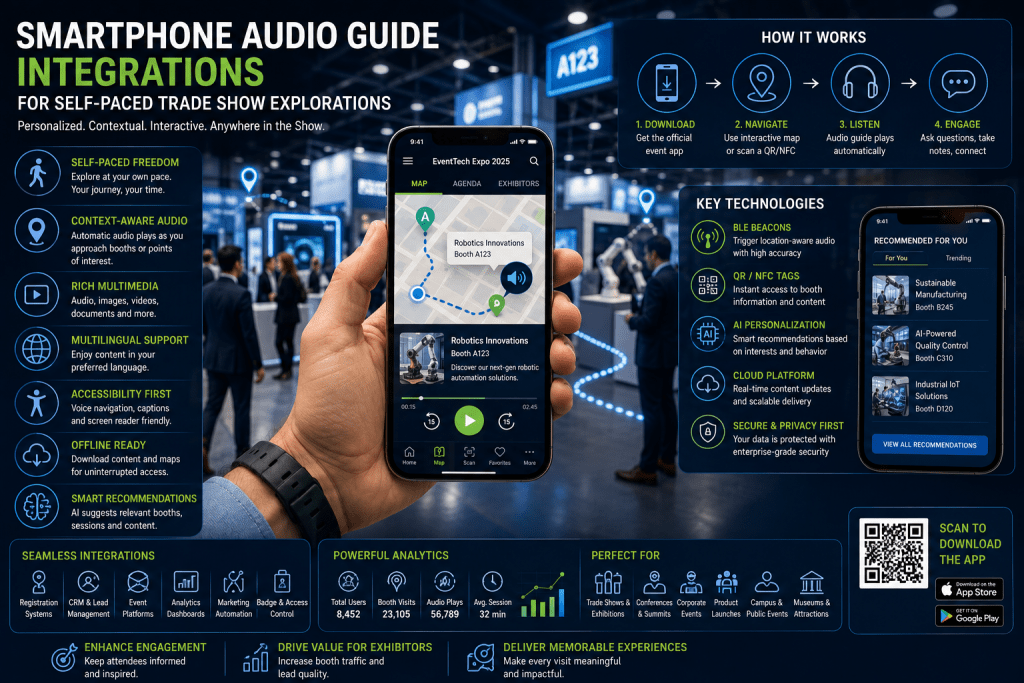
Smartphone audio guide integrations offer a more flexible approach by transforming attendees’ mobile devices into intelligent event companions. Using location awareness, cloud content delivery, Bluetooth Low Energy (BLE) beacons, Near Field Communication (NFC), QR codes, and artificial intelligence (AI), these systems deliver contextual audio commentary as attendees navigate exhibition spaces at their own pace. Rather than replacing exhibitors or event staff, smartphone audio guides enhance exploration by providing relevant information precisely when and where participants need it.
For event technology professionals, smartphone audio guide ecosystems represent an increasingly important convergence of mobile computing, indoor positioning, content management, analytics, and personalization technologies that improve attendee engagement while reducing operational complexity.
Why Traditional Trade Show Navigation Falls Short
Large exhibitions often span multiple halls containing hundreds of booths distributed across thousands of square meters.
Attendees commonly encounter challenges such as:
- Difficulty locating priority exhibitors
- Overlapping presentation schedules
- Information overload
- Limited time for exploration
- Missed demonstrations
- Inconsistent exhibitor interactions
- Navigation confusion
Guided tours provide structure but rarely accommodate individual professional interests.
Self-paced audio guidance addresses this limitation by allowing each attendee to create a personalized exploration journey.
What Is a Smartphone Audio Guide System?
A smartphone audio guide system delivers location-aware spoken content through an attendee’s personal mobile device.
Instead of requiring dedicated audio receivers, participants use an event application or web-based platform to access multimedia content as they move through the venue.
Typical features include:
- Contextual audio narration
- Interactive maps
- Indoor navigation
- Personalized recommendations
- Multilingual content
- Accessibility support
- Offline playback
- Bookmarking and notes
The system adapts dynamically according to attendee preferences, registration profiles, and real-time event conditions.
Core Technology Architecture
Successful smartphone audio guides rely on multiple integrated technologies.
Mobile Event Applications
The mobile application serves as the primary user interface.
Capabilities generally include:
- Personalized agendas
- Interactive venue maps
- Audio playback
- Exhibitor profiles
- Product catalogs
- Networking tools
- Push notifications
- Session management
Cloud synchronization ensures updates remain available throughout the event.
Indoor Positioning Technologies
Accurate indoor positioning enables contextual content delivery.
Common technologies include:
- Bluetooth Low Energy (BLE) beacons
- Wi-Fi positioning
- Ultra-Wideband (UWB)
- QR code checkpoints
- NFC tags
- Computer vision
- GPS for outdoor areas
Each technology offers different trade-offs involving accuracy, deployment complexity, infrastructure cost, and battery consumption.
Cloud Content Management
Audio, images, videos, brochures, and multilingual resources are managed through centralized cloud platforms.
Content updates become immediately available without requiring attendees to reinstall applications.
This enables exhibitors to publish product announcements, schedule changes, or promotional materials in real time.
Context-Aware Audio Experiences
The greatest advantage of smartphone audio guides is contextual personalization.
As attendees approach designated locations, the application can automatically present:
- Company introductions
- Product demonstrations
- Technical specifications
- Speaker interviews
- Innovation highlights
- Safety instructions
- Historical background
Audio playback minimizes the need for participants to continuously read screens while navigating crowded exhibition halls.
This contributes to a more comfortable and immersive visitor experience.
Artificial Intelligence and Personalization
Artificial intelligence increasingly enhances self-guided exploration.
Recommendation engines analyze:
- Registration categories
- Professional interests
- Previous booth visits
- Session attendance
- Search history
- Engagement patterns
- Networking preferences
Based on these signals, AI suggests relevant exhibitors, educational sessions, networking opportunities, and product demonstrations.
Generative AI can also summarize technical information into concise audio briefings tailored to different audience segments, such as engineers, executives, buyers, or investors.
Integration with Event Technology Platforms
Smartphone audio guides deliver maximum value when integrated into the broader event ecosystem.
Registration Platforms
Registration profiles personalize recommended content while respecting attendee permissions and privacy preferences.
Customer Relationship Management Systems
With participant consent, booth visits and content interactions synchronize automatically with CRM platforms.
This provides exhibitors with richer engagement insights while reducing manual lead qualification.
Analytics Dashboards
Organizers gain visibility into:
- Visitor movement
- Audio completion rates
- Popular exhibits
- Navigation paths
- Dwell time
- Content engagement
- Recommendation effectiveness
These insights support continuous optimization of exhibition layouts and future event planning.
Learning Management Systems
Educational trade shows can combine audio guides with continuing education programs, quizzes, digital certificates, and learning progress tracking.
Accessibility Benefits
Smartphone audio guides significantly improve accessibility.
Important capabilities include:
- Screen reader compatibility
- Voice navigation
- Adjustable playback speed
- Multilingual narration
- Closed captions
- Text alternatives
- Hearing-assistance integration
Participants with visual impairments particularly benefit from spoken navigation and contextual descriptions.
Similarly, multilingual support enables international attendees to experience exhibitions in their preferred language without requiring dedicated interpretation equipment.
Operational Advantages
Smartphone audio guides produce measurable benefits for organizers, exhibitors, and attendees.
Reduced Hardware Costs
Using attendees’ personal devices eliminates the need to distribute, maintain, sanitize, and recover dedicated audio receivers.
Flexible Content Updates
Cloud-based content management allows exhibitors to update presentations instantly throughout the event.
Personalized Exploration
Participants spend more time engaging with content aligned to their professional interests.
Improved Data Insights
Digital interactions provide far richer analytics than traditional printed maps or static signage.
Implementation Challenges
Successful deployment requires careful planning.
Indoor positioning systems must be calibrated accurately to avoid triggering incorrect audio content.
Battery optimization is essential because continuous positioning services may increase mobile power consumption.
Content quality also matters. Audio should remain concise, professionally narrated, and synchronized with physical exhibits.
Connectivity presents another consideration. Large exhibition venues should provide reliable wireless coverage or support offline caching for downloaded content.
Privacy remains equally important. Organizers should communicate clearly how location information is collected, processed, retained, and protected while offering transparent consent controls.
Future Trends
Smartphone audio guides are evolving into intelligent digital companions.
Emerging innovations include:
- AI voice assistants
- Spatial audio navigation
- Augmented reality integration
- Digital twins of exhibition halls
- Voice-controlled search
- Context-aware conversational AI
- Wearable device integration
- Predictive route optimization
Future systems may automatically generate personalized exhibition itineraries that adapt continuously according to attendee interests, meeting schedules, crowd density, and available time.
Combined with AI-powered networking recommendations and immersive digital experiences, smartphone audio guides will become increasingly central to personalized event journeys.
Conclusion
Smartphone audio guide integrations are transforming self-paced trade show exploration by combining mobile technology, indoor positioning, cloud content management, artificial intelligence, and event platform integration into a unified attendee experience. Rather than replacing human interaction, these systems enhance discovery by delivering timely, contextual, and personalized information that helps participants navigate complex exhibition environments more efficiently. With improved accessibility, richer analytics, reduced operational costs, and scalable multilingual support, smartphone audio guides provide significant value for organizers, exhibitors, and attendees alike. As event technology continues advancing toward intelligent, data-driven experiences, mobile audio guidance will play an increasingly important role in creating personalized and engaging trade show journeys.