


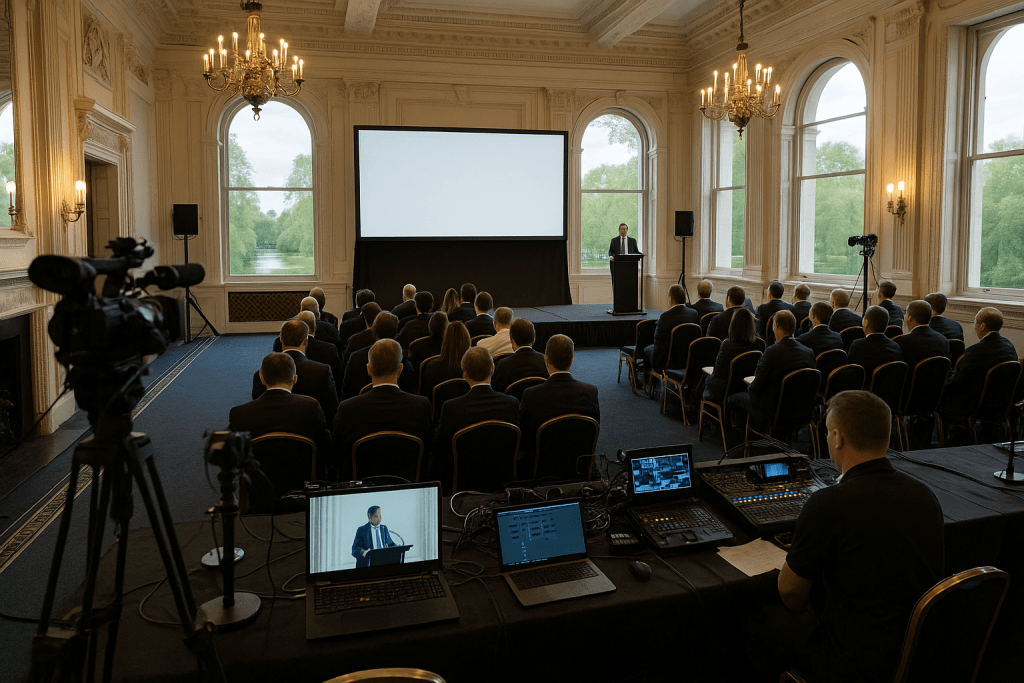
In central London, the Royal Society has emerged as a notable option for organisers seeking a blend of historic prestige and contemporary event infrastructure. The Grade I listed building at Carlton House Terrace, overlooking The Mall and St James’s Park, is being used for conferences, meetings, lectures, dinners and receptions that increasingly rely on modern audio-visual and hybrid event capabilities.
While best known as the UK’s national academy of sciences, the Royal Society’s headquarters also operates as a commercial venue, positioning itself at the intersection of scientific heritage and business events. Its combination of period architecture and upgraded technical facilities is attracting planners looking to host high-profile gatherings in a central, easily accessible London location.
Background and industry context
London remains one of the most competitive meeting and event markets in Europe, with venues under pressure to support in-person, virtual and hybrid formats. Historic buildings in particular are being challenged to modernise without compromising conservation requirements or guest experience.
Over the past decade, organisers have raised expectations around integrated AV, streaming capabilities, and on-site technical support. Venues that once traded primarily on location or architectural interest are now investing in infrastructure that can support multi-room programmes, international speakers joining remotely, and content capture for post-event use.
Institutional venues such as learned societies and professional bodies have increasingly entered this space, leveraging their reputations and central locations while upgrading facilities to compete with purpose-built conference centres and hotels.
Key developments at the Royal Society venue
The Royal Society’s building offers a suite of spaces of varying capacities, enabling it to cater to different event formats, from scientific symposia and policy briefings to corporate training sessions and networking receptions.
Typical configurations include:
- Lecture and presentation rooms that support formal talks, panel discussions, and plenary sessions.
- Meeting and breakout rooms for workshops, smaller group work, and parallel tracks.
- Reception and dining spaces suitable for networking, sponsor activations and formal dinners.
Within this heritage setting, the venue has incorporated modern event facilities such as integrated AV, projection, sound systems and connectivity suitable for hosting complex business events. While specific hardware details and technology providers are not publicly itemised, the space is positioned to support presentations, live talks and content sharing in line with contemporary conference expectations.
In addition to physical infrastructure, the building’s central London location enables easy access for delegates using public transport, with nearby national and international links for attendees travelling from outside the capital or abroad. The views across The Mall and St James’s Park also make the venue attractive for events requiring a prestigious backdrop to welcome stakeholders, sponsors or government representatives.
Industry impact
The use of the Royal Society as a commercial event venue reflects a broader trend in which cultural and academic institutions open up their buildings to the meetings and events market. This provides organisers with a wider choice of venues that combine narrative-rich spaces with the baseline technology needed for modern programmes.
For the London market, the availability of Grade I listed buildings that can function as fully equipped event spaces increases the city’s ability to host high-level international gatherings, particularly in sectors such as science, policy, technology, and professional services. These venues can lend additional credibility and context to conferences that deal with research, innovation and public discourse.
From an industry perspective, the adaptation of heritage venues also illustrates how event technology is now treated as essential infrastructure, not an optional add-on. Even buildings with strict conservation requirements are finding ways to integrate connectivity, AV, and hybrid-supporting capabilities into their operations.
Why this matters for event professionals and technology providers
For event planners, the Royal Society offers an example of how historic institutions can meet current technical needs without losing their character. This has several implications for professionals selecting venues and specifying technology:
- Content and branding: The scientific and academic heritage of the building can enhance the positioning of conferences focused on research, innovation, healthcare, sustainability or policy, supporting stronger delegate engagement and stakeholder perception.
- Hybrid potential: While individual event requirements will vary, the integration of modern facilities in such venues indicates the potential to support remote speakers, live streaming and on-demand content capture, which are increasingly common in larger corporate and association events.
- Stakeholder experience: Hosting in a central, easily accessible location with recognisable surroundings simplifies logistics for attendees and can help increase registration and in-person participation.
- Collaboration opportunities: Technology suppliers working with heritage venues must design solutions that are both discreet and flexible, enabling sophisticated production without intrusive infrastructure that could conflict with conservation guidelines.
For AV and event tech providers, venues like the Royal Society underscore the need for adaptable systems that work within architectural constraints. This often means modular equipment, carefully managed cabling, wireless solutions where appropriate, and close collaboration with venue management and heritage bodies.
Conclusion
The Royal Society’s venue at Carlton House Terrace exemplifies how historic institutions are repositioning their spaces for contemporary business events. By combining a central London address and centuries of scientific history with upgraded event facilities, the venue is aligned with organizers’ growing demands for both experiential value and robust technology.
As the meetings and events sector continues to refine its approach to hybrid formats and digital content, venues that can balance character with capability are likely to remain in demand. For planners, production teams and technology providers, the Royal Society demonstrates the direction that many heritage sites are taking to stay relevant within a fast-evolving event technology landscape.