


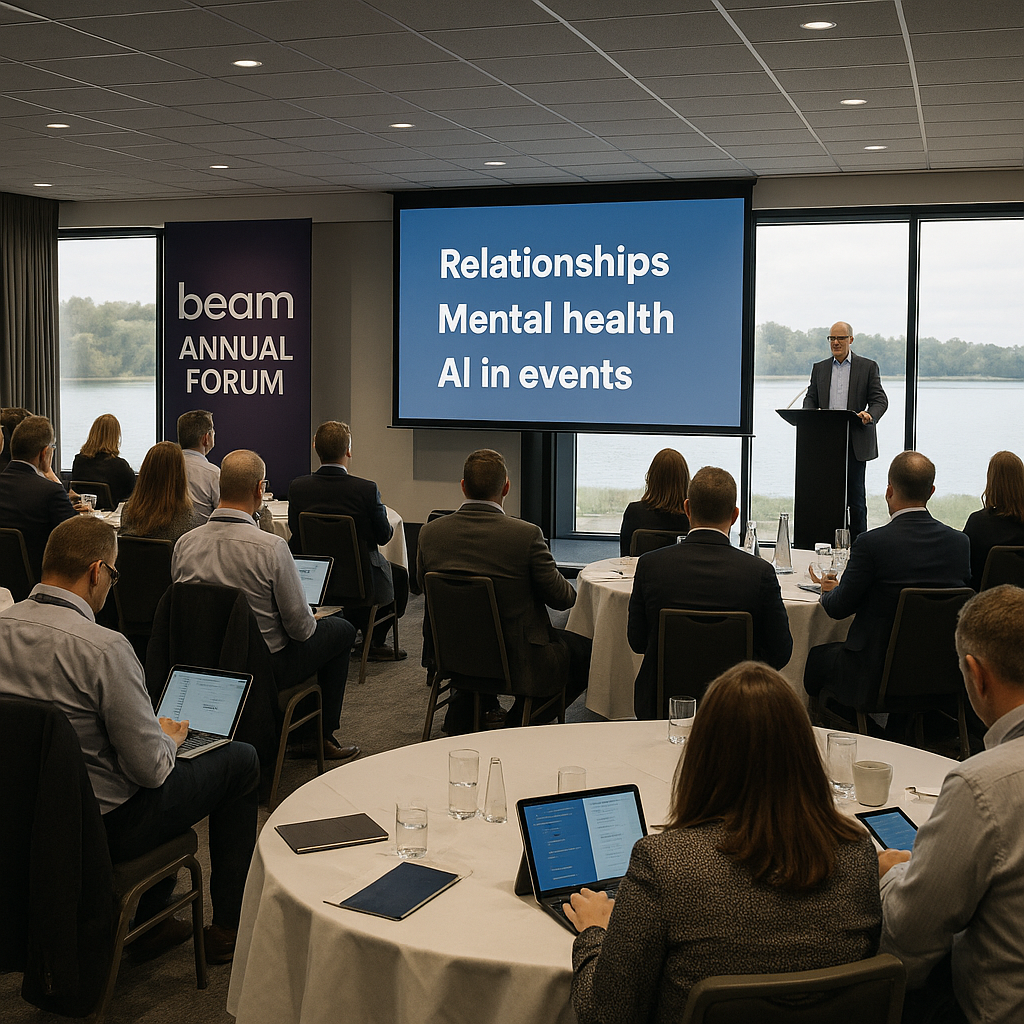
The 2026 edition of the beam Annual Forum brought together agency owners, venue operators and service providers to examine how business relationships, mental wellbeing and emerging technologies are reshaping the business events sector. Hosted at Wyboston Lakes Resort on 16–17 July, the two-day gathering centred on the theme “Relationships 3.0 – From Connection to Momentum,” reflecting a shift from simple networking towards more structured, long-term collaboration.
The forum combined keynotes, peer-to-peer discussion and practical workshops for members of beam, the trade association representing business events agencies and their supply chain partners. Sessions explored the commercial realities facing meetings and conference organisers, with particular emphasis on workforce pressures, digital transformation and the changing expectations of corporate clients.
Background and industry context
The event took place at a time when the business events industry continues to balance sustained demand with rising costs, talent shortages and evolving attendee behaviour. Agencies and venues are under pressure to deliver higher value experiences while simultaneously demonstrating return on investment, reducing environmental impact and supporting the wellbeing of their teams.
Across the sector, hybrid formats, data-driven decision making and automation are now embedded in many organisations’ operations. However, the sessions at the forum highlighted that human relationships between agencies, venues, suppliers and clients remain central to navigating rapid change. The “Relationships 3.0” framing reflected a push towards deeper strategic partnerships, rather than transactional buying, as organisations look to share risk and innovation.
Key developments and themes from the forum
Speakers and panel discussions across the two days addressed a broad mix of operational and strategic topics, with recurring focus on people, process and technology.
- Mental health and workforce sustainability: Several contributors emphasised the mental health challenges that persist in event delivery teams, particularly around long hours, compressed timelines and client expectations. The forum highlighted the need for organisations to embed wellbeing into project planning, leadership training and everyday operations rather than treating it as an add-on.
- Relationships as a commercial lever: The agenda repeatedly returned to the idea that robust relationships between agencies, venues and suppliers directly influence financial performance, resilience and innovation. Delegates discussed contractual transparency, fair payment terms, and collaborative forecasting as mechanisms to stabilise supply chains and protect margins.
- AI and digital tools: Sessions explored how artificial intelligence and automation are beginning to influence proposal writing, audience analytics, content translation and event marketing. While there was recognition of the productivity benefits, speakers also raised concerns around data quality, intellectual property and the need for clear governance.
- Sector advocacy: With business events increasingly recognised as an economic driver and a platform for knowledge exchange, the forum addressed the importance of coordinated industry representation. Organisers examined how collective data and joint messaging can improve engagement with policymakers, destination stakeholders and corporate decision-makers.
Throughout the programme, interactive segments allowed delegates to share examples of how they are applying new processes and technologies in live environments, from hybrid meeting formats to automated reporting and on-site wellbeing measures.
Industry impact and emerging priorities
While the forum was primarily a member event, the themes reflect broader priorities across the meetings and events ecosystem. Three areas in particular emerged as influential for organisations planning their next phase of investment and strategy.
- Codifying relationship management: Discussions suggested that many agencies and venues are moving beyond informal relationship-building towards more formal frameworks. These include joint business planning with key partners, shared performance metrics and structured feedback loops after major events. The goal is to reduce friction in planning cycles and create more predictable outcomes for clients.
- Balancing automation with human service: The exploration of AI tools at the forum underscored a cautious but active interest in automation. For many organisations, the priority is to apply technology to repetitive tasks such as data entry, basic communications and logistics management, allowing staff to focus on creative design, stakeholder management and strategic consulting.
- Embedding wellbeing into event design: The mental health focus extended beyond internal teams to encompass delegate experience. Organisers discussed how agenda design, venue selection, onsite scheduling and digital communications can reduce stress and support engagement, from quieter networking formats to realistic time buffers between sessions.
Collectively, these priorities indicate a shift from survival and recovery thinking towards longer-term planning, with relationship health and workforce sustainability treated as core business metrics.
Why this matters for event professionals and technology providers
For agencies, corporate planners and venues, the discussions at the forum underline that commercial performance is increasingly tied to how effectively organisations manage their ecosystem of partners and tools.
- Event professionals: Planners and account teams are being asked to operate as strategic advisors, drawing on data, technology and industry insight to guide clients on format, investment and impact. Strengthening relationships with suppliers and venues can unlock better pricing models, access to innovation and greater flexibility when navigating last-minute changes.
- Technology providers: Platform and solution vendors can take cues from the forum’s themes in how they design and position products. Tools that support collaboration across agencies, venues and clients—such as shared dashboards, integrated communication channels and transparent reporting—are likely to be prioritised. Equally, features that help protect staff wellbeing, including workload visibility and automation of repetitive tasks, may become more prominent in procurement decisions.
- Cross-sector collaboration: The emphasis on advocacy and collective representation suggests growing opportunities for joint initiatives across associations, destinations, venues and technology firms. Shared standards for data, sustainability reporting and attendee experience could help the sector present a more unified case to both government and global corporate buyers.
As AI and automation penetrate more aspects of event planning, the industry’s ability to maintain trust, psychological safety and fair commercial terms will be central to adopting new tools at scale.
Conclusion
The beam Annual Forum 2026 underscored that while technology and data continue to reshape how events are designed and delivered, the foundation of the business events sector remains grounded in relationships—between agencies, venues, suppliers, clients and the people working behind the scenes.
By placing mental health, collaboration and responsible use of AI at the forefront, the forum reflected a maturing industry mindset. Rather than treating these issues as separate topics, delegates explored how they intersect to influence profitability, client satisfaction and organisational resilience.
For event professionals and technology providers, the conversations at Wyboston Lakes signal that future competitiveness will depend not only on platforms and infrastructure, but also on how organisations structure their partnerships, protect their teams and translate connections into sustained momentum.