


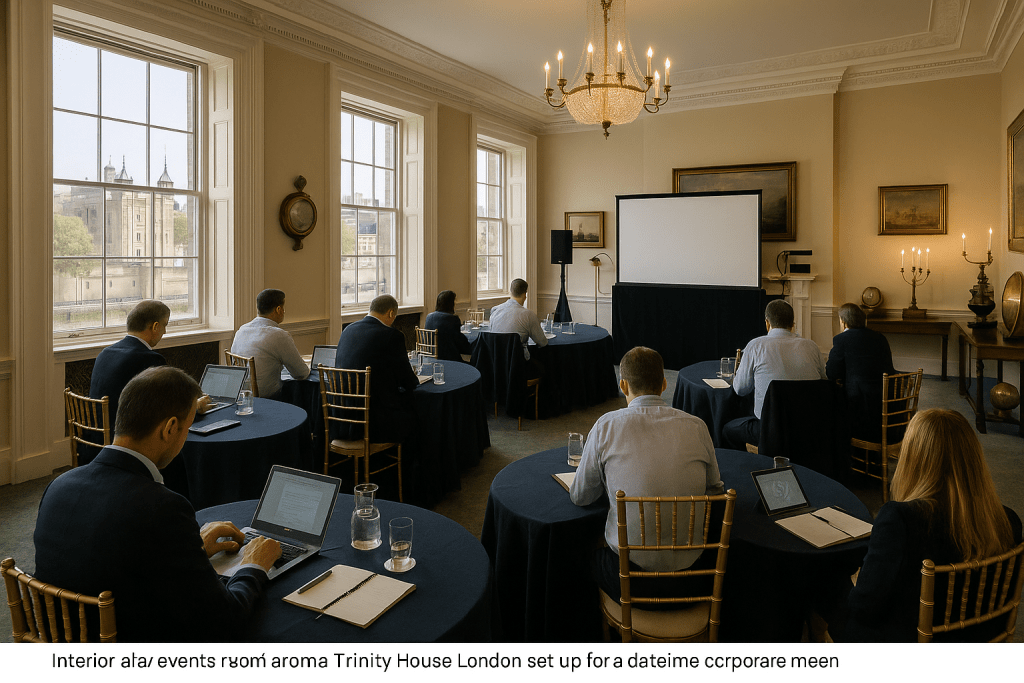
Trinity House on Tower Hill, overlooking the historic Tower of London, is sharpening its profile as a multi-purpose events venue, combining heritage architecture with flexible spaces for weddings, corporate functions and hybrid meetings.
The Georgian building, home to the General Lighthouse Authority, has long been associated with maritime history. Today, its events team is emphasising the venue’s capacity to support a range of event formats while retaining the character that comes with more than two centuries of institutional use.
Background and heritage setting
Trinity House occupies a prominent location close to the River Thames, adjacent to one of London’s most visited landmarks. The current building dates back to the late 18th century and houses collections of maritime artefacts that reflect its role in the safety of shipping around the UK coastline.
The venue offers five event spaces, four of which provide direct views of the Tower of London and its surrounding precincts. The interiors are characterised by high ceilings and tall sash windows, providing natural light and a sense of scale that is often sought after for both social and business events.
Over several decades, the in-house events team has overseen a steady programme of civil ceremonies and receptions, with the venue becoming a fixture in the market for couples seeking a central London location with a historic backdrop. At the same time, the building has remained a working headquarters, which has influenced the way spaces have been adapted for external hire.
Key developments and venue offer
While Trinity House is widely recognised as a setting for weddings, its management is increasingly positioning the site as a versatile venue for a broader mix of events, including conferences, product launches, award ceremonies and executive meetings. The five rooms can accommodate different seating layouts, from theatre-style and cabaret to boardroom and banquet configurations.
Event organisers have access to rooms that feature maritime memorabilia, artwork and historical pieces, including items linked to royal and naval history. Notable objects, such as the brass bell from the former Royal Yacht, provide focal points within the event spaces and are often used as conversation starters or informal thematic anchors for event design.
For planners, this combination of heritage and functionality supports a variety of event formats. Spaces can be configured for plenary sessions, breakouts, formal dining or receptions. The abundance of natural light and the visual impact of the Tower of London views are leveraged to enhance delegate experience, particularly for international audiences or clients seeking a recognisably London setting.
The events team provides guidance on logistics, including room layouts, flow between spaces and coordination with external suppliers such as caterers and audiovisual partners. While the building’s listed status influences what can be altered physically, the management has worked within those constraints to accommodate contemporary event requirements, including digital and hybrid elements where possible.
Industry impact and competitive positioning
London’s venue market remains highly competitive, with corporate buyers and agencies evaluating spaces not only on capacity and cost but on distinctiveness and delegate appeal. Historic buildings that can support modern production requirements are often well placed to attract premium business, particularly in sectors such as finance, professional services and international associations.
Trinity House’s positioning aligns with an ongoing trend in the events sector: the use of heritage and cultural venues for business-focused events. Organisers are frequently looking beyond traditional conference centres to locations that can offer a sense of place and narrative, especially for brand launches, client entertainment and leadership gatherings.
The move to emphasise flexible room formats and the venue’s track record in handling formal ceremonies underlines a broader shift across the industry, where venues with strong consumer reputations (for example in weddings or private events) look to balance their calendars with corporate bookings and repeat B2B clients.
Why this matters for event professionals and technology providers
For event planners, Trinity House represents the type of historic site that must carefully integrate event technology without compromising building fabric or visitor experience. This creates opportunities and constraints for technology providers working in areas such as temporary AV installations, streaming, networking infrastructure and interactive displays.
Vendors specialising in low-impact or non-invasive setups may find particular relevance in venues of this kind, where cable runs, rigging points and equipment footprints are limited by conservation requirements. Solutions that enable rapid deployment and removal of hybrid event technologies—such as portable streaming kits, compact sound systems and wireless presentation tools—are likely to be prioritised.
From a planning perspective, organisers considering Trinity House or comparable heritage venues should assess:
- How hybrid and virtual components can be supported without permanent hardware installations.
- What bandwidth and connectivity options are available, and where additional infrastructure might be needed.
- How lighting and acoustics can be optimised while respecting historic interiors.
- How storytelling elements, including maritime artefacts and views of the Tower of London, can be integrated into content and staging.
The venue’s long experience with ceremonial formats may also appeal to organisations staging awards, graduations or formal signings, where protocol and staging details are critical. In these contexts, event technology often needs to be as unobtrusive as possible, focusing on reliable audio, discreet recording and clean livestream outputs rather than large-scale production.
Conclusion
Trinity House is leveraging its Georgian architecture, maritime heritage and Tower Hill location to maintain relevance in a changing events landscape. By combining a longstanding focus on weddings and civil ceremonies with an expanded pitch to corporate and hybrid event organisers, the venue illustrates how historic buildings are evolving their offer to meet contemporary expectations.
For event professionals and technology providers, the site exemplifies both the opportunities and challenges of working within protected heritage spaces. As demand grows for distinctive, experience-led venues, the ability to layer modern event infrastructure onto historic settings—without diminishing their character—will remain an important differentiator in London’s venue ecosystem.