


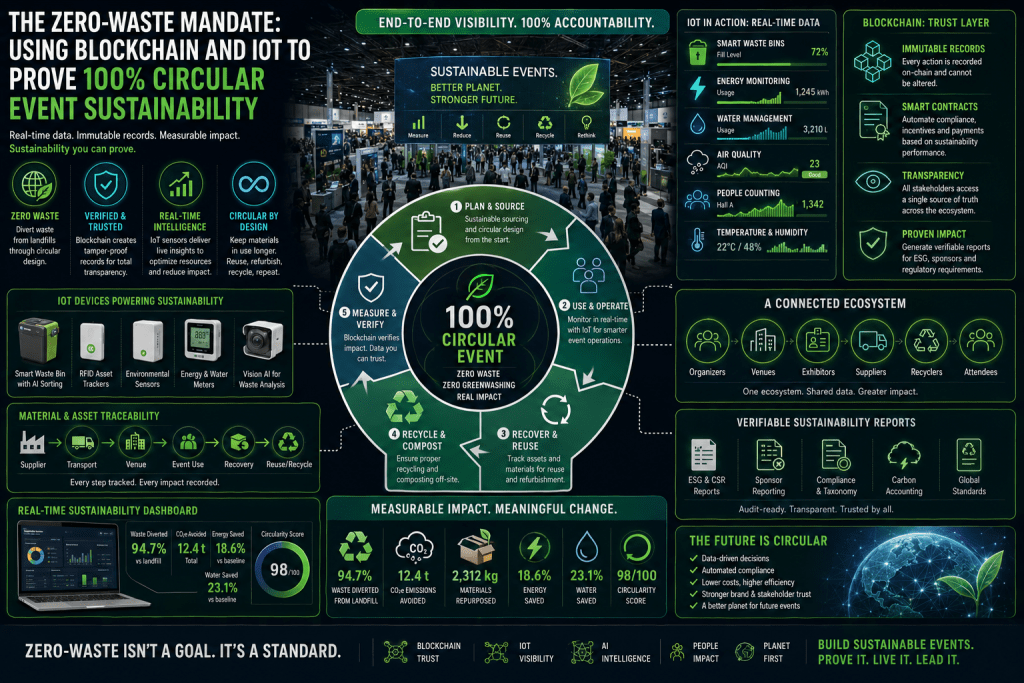
Sustainability has shifted from a branding initiative to a measurable operational requirement within the event industry. Conferences, trade shows, exhibitions, festivals, sports events, and corporate summits are facing increasing pressure from governments, sponsors, attendees, and ESG-focused stakeholders to demonstrate verifiable environmental accountability.
For years, event sustainability efforts largely focused on visible initiatives such as reusable signage, reduced paper printing, compostable food containers, and carbon offset programs. While valuable, these approaches often lacked transparency, measurable verification, and end-to-end accountability.
Today, a new generation of event technology is transforming sustainability from a claims-based model into a data-driven verification system. By combining blockchain infrastructure, IoT-enabled monitoring, AI analytics, digital twins, and smart supply chain tracking, event organizers are beginning to build fully traceable circular event ecosystems capable of proving waste reduction, material reuse, emissions tracking, and resource accountability in real time.
This evolution is being accelerated by what many industry observers are calling the “zero-waste mandate” — the growing expectation that events must not only reduce waste, but also provide auditable proof of circular sustainability performance.
In this emerging model, sustainability is no longer treated as a post-event reporting exercise. Instead, it becomes an active operational intelligence layer embedded throughout the event lifecycle.
Why Traditional Event Sustainability Reporting Is Failing
Table of Contents
ToggleConventional sustainability reporting in events often relies heavily on estimates, vendor declarations, and fragmented data collection.
Typical reporting methods include:
- Manual waste audits
- Vendor self-reporting
- Spreadsheet-based tracking
- Estimated carbon calculations
- Post-event sustainability summaries
While these approaches provide broad indicators, they frequently lack:
- Real-time visibility
- Supply chain traceability
- Independent verification
- Immutable reporting
- Granular material tracking
As ESG regulations tighten and greenwashing scrutiny increases, organizations are facing growing pressure to validate sustainability claims with measurable evidence.
This is particularly important for large enterprise events and global exhibitions where sustainability commitments increasingly affect:
- Sponsor partnerships
- Venue selection
- investor perception
- procurement decisions
- attendee trust
The industry is moving toward verifiable sustainability infrastructure rather than aspirational reporting.
What Is a Circular Event Ecosystem?
A circular event ecosystem is designed around continuous material reuse, resource optimization, waste diversion, and traceable sustainability accountability.
Unlike traditional linear event models based on “produce, consume, discard,” circular systems aim to maintain materials and resources within closed operational loops.
Examples include:
- Reusable booth structures
- Trackable material recovery
- Smart catering waste reduction
- Asset recirculation systems
- Modular staging infrastructure
- Circular merchandise programs
- Closed-loop packaging systems
The challenge historically has been proving these circular processes with transparency and accuracy.
This is where blockchain and IoT technologies become critical.
The Role of IoT in Real-Time Sustainability Monitoring
IoT infrastructure forms the sensing and data collection layer of modern sustainability ecosystems.
Connected devices across venues and supply chains continuously monitor environmental and operational conditions.
Typical IoT systems include:
- Smart waste bins
- RFID asset tracking
- Environmental sensors
- Energy monitoring systems
- Water usage sensors
- Occupancy analytics
- Smart logistics trackers
- Cold chain monitoring devices
These systems generate real-time operational data that allows organizers to monitor sustainability performance continuously during the event itself.
Smart Waste Management Systems
Waste management is one of the largest sustainability challenges in large-scale events.
IoT-enabled waste systems can monitor:
- Fill levels
- Waste contamination
- Recycling separation accuracy
- Disposal timing
- Material composition
- Waste diversion rates
Smart bins equipped with computer vision and sensor technology can automatically classify waste streams and optimize collection routes dynamically.
This improves:
- Recycling accuracy
- labor efficiency
- contamination reduction
- diversion performance
More importantly, it creates verifiable waste tracking datasets rather than estimated reporting.
RFID and Material Traceability
Circular sustainability requires accurate tracking of physical assets across their lifecycle.
RFID and IoT-enabled tracking systems are increasingly being used for:
- Booth materials
- furniture
- staging equipment
- catering inventory
- reusable packaging
- attendee badges
- event signage
Each asset can be digitally tracked through:
- deployment
- usage
- recovery
- refurbishment
- redistribution
- recycling
This creates measurable circularity visibility across event operations.
For example, organizers can verify:
- how many times booth components were reused
- where materials originated
- whether assets entered recycling streams properly
- how long equipment remains operational
This level of traceability is becoming increasingly important for ESG reporting and procurement accountability.
Blockchain as the Trust and Verification Layer
While IoT systems generate sustainability data, blockchain infrastructure provides immutable verification and auditability.
Immutable Sustainability Records
Blockchain systems create tamper-resistant records of:
- waste diversion metrics
- energy consumption
- material reuse
- emissions tracking
- vendor compliance
- logistics movement
Once recorded, data cannot easily be altered retroactively.
This significantly improves reporting credibility.
Smart Contracts for Sustainability Compliance
Smart contracts automate sustainability verification workflows.
Examples include:
- verifying recycling targets
- releasing vendor payments upon sustainability compliance
- validating carbon reduction milestones
- tracking circular procurement requirements
This reduces reliance on manual auditing processes.
Supply Chain Transparency
Blockchain platforms can connect event sustainability data across multiple stakeholders including:
- venues
- suppliers
- exhibitors
- logistics providers
- catering partners
- recycling facilities
This creates end-to-end transparency across complex event ecosystems.
AI and Predictive Sustainability Optimization
AI systems are increasingly integrated into circular event management platforms.
Predictive Waste Reduction
Machine learning models analyze:
- attendee behavior
- food consumption patterns
- crowd density
- inventory usage
- energy demand trends
to predict waste generation before it occurs.
This enables organizers to proactively optimize:
- catering production
- material deployment
- staffing allocation
- energy distribution
Carbon Intelligence Platforms
AI-driven sustainability engines can calculate:
- real-time carbon emissions
- energy efficiency performance
- transportation impact
- vendor sustainability scores
This allows organizers to monitor environmental impact dynamically rather than waiting for post-event audits.
Automated ESG Reporting
AI systems increasingly automate sustainability reporting workflows by aggregating data across IoT and blockchain systems into standardized ESG frameworks.
This reduces reporting complexity while improving accuracy.
Digital Twins and Circular Venue Simulation
Some advanced venues are now integrating sustainability systems into digital twin environments.
Digital twins create real-time virtual replicas of event operations using live IoT data.
These systems allow organizers to simulate:
- waste flow patterns
- crowd-related energy consumption
- HVAC optimization
- logistics efficiency
- material recovery workflows
before operational decisions are implemented physically.
This improves sustainability planning while reducing resource waste.
Operational and Business Benefits
The shift toward verifiable circular sustainability creates several strategic advantages.
Improved ESG Credibility
Immutable sustainability verification improves trust among:
- sponsors
- investors
- attendees
- regulators
- corporate stakeholders
This reduces greenwashing concerns significantly.
Better Operational Efficiency
Real-time resource monitoring improves:
- waste reduction
- energy optimization
- logistics efficiency
- inventory management
This can lower operational costs substantially.
Stronger Sponsor Alignment
Brands increasingly seek measurable sustainability partnerships.
Events capable of proving verified environmental performance become more attractive to ESG-focused sponsors.
Regulatory Readiness
As sustainability disclosure regulations expand globally, verifiable reporting infrastructure provides stronger compliance positioning.
Challenges and Adoption Barriers
Despite its potential, circular event infrastructure remains complex to implement.
Integration Complexity
Sustainability ecosystems require interoperability between:
- IoT devices
- blockchain networks
- venue systems
- vendor platforms
- logistics software
- analytics engines
Fragmented infrastructure remains a major challenge.
Data Quality Risks
Blockchain systems are only as reliable as the data entering them.
Inaccurate sensor readings or poor operational inputs can still compromise reporting integrity.
Infrastructure Costs
Deploying smart sustainability systems requires investment in:
- sensors
- connectivity
- analytics platforms
- blockchain infrastructure
- integration engineering
This may limit adoption among smaller event operators.
Stakeholder Coordination
Circular ecosystems depend on participation from multiple external vendors and suppliers.
Achieving standardized sustainability cooperation across complex event supply chains remains difficult.
The Future of Circular Event Intelligence
The next generation of sustainability systems is expected to become increasingly autonomous and predictive.
Emerging developments include:
- AI-driven autonomous waste orchestration
- tokenized carbon accountability systems
- self-optimizing smart venues
- blockchain-based circular procurement marketplaces
- robotic recycling infrastructure
- automated ESG compliance auditing
- decentralized sustainability scoring networks
As these technologies mature, sustainability verification may become embedded directly into event infrastructure rather than managed as a separate reporting function.
Conclusion
The event industry is entering a new era where sustainability claims must be supported by measurable, auditable, and real-time operational evidence. Blockchain infrastructure, IoT monitoring systems, AI analytics, and digital twin technologies are collectively transforming event sustainability from fragmented reporting into verifiable circular intelligence.
Their significance extends beyond environmental branding. These systems improve operational efficiency, strengthen ESG credibility, reduce waste, optimize resource usage, and provide transparent accountability across increasingly complex event ecosystems.
Most importantly, the rise of verifiable circular event infrastructure reflects a larger industry transformation where sustainability is no longer viewed as an optional initiative, but as a core operational requirement embedded directly into the architecture of modern event design.

