


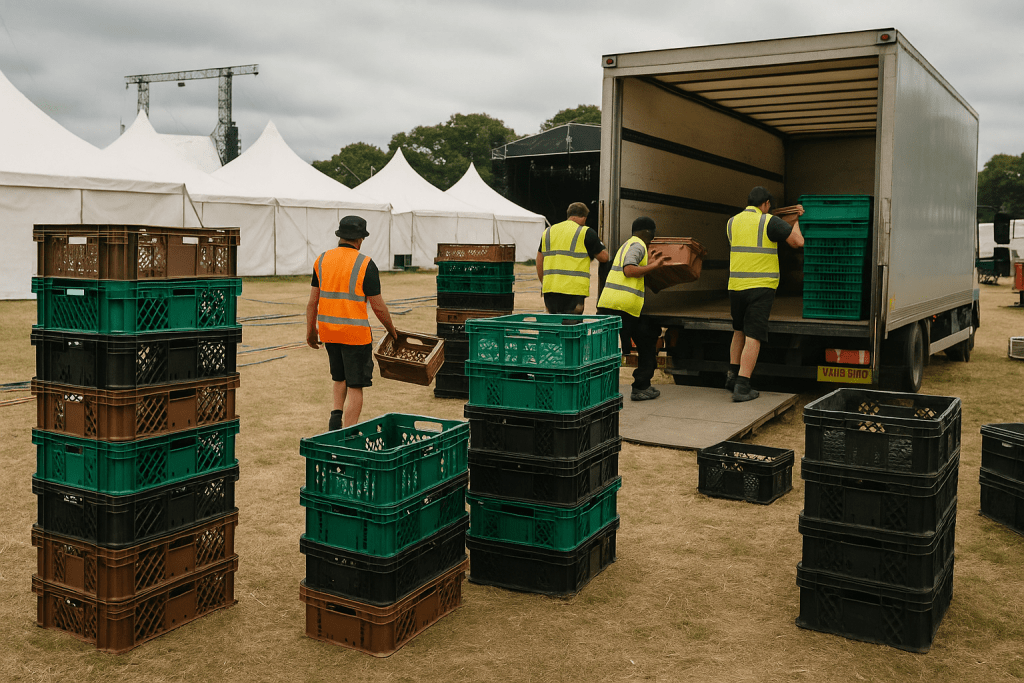
Bakers Basco is calling on festivals, caterers and event suppliers to take stronger responsibility for the management of reusable equipment, after recovering more than 20,000 bakery items from event sites during the 2025 outdoor season in the UK.
The organisation, which manages a shared pool of reusable bread baskets and related distribution equipment on behalf of several major bakery brands, has highlighted the scale of equipment loss at outdoor events and the resulting environmental and financial impact. Its latest figures suggest that large volumes of items designed for repeated use are still being abandoned, misused or absorbed into on-site operations rather than returned to the supply chain.
Background: reusable assets in the event supply chain
Reusable logistics assets such as bread baskets, trolleys and crates form a critical but often overlooked layer of the event supply chain. These items are used to transport baked goods and other food products from bakeries and distribution centres to festivals, sports fixtures, concerts and temporary venues across the country.
Unlike single-use packaging, these plastic and metal assets are engineered for repeated circulation over many years. They are owned by specialist pooling organisations or manufacturers and supplied to bakeries and caterers under strict terms of use. When equipment is not returned, it must be replaced, driving additional production, energy consumption and transport emissions.
Outdoor events can be particularly challenging environments for controlling reusable equipment. Multiple contractors operate on site, turnover of temporary staff is high and pressure on build and breakdown schedules can make it difficult to track assets effectively. Items may be repurposed for storage, left behind in back-of-house areas or disposed of once the event closes.
Key developments: 20,000 items recovered across 2025 events
During the 2025 outdoor events season, Bakers Basco reported the recovery of over 20,000 reusable items from festival sites, temporary catering compounds and associated locations. The tally, covering a defined seasonal period, reflects items that had either been left behind, diverted from their intended use or integrated into site operations without permission.
The organisation operates an investigative and recovery team that locates and retrieves its equipment from locations where it should not be held, including event sites, depots and catering facilities. The latest figures reinforce a pattern that has been building over several years: as the outdoor events calendar grows, so does the volume of reusable distribution equipment that fails to make its way back into circulation.
While detailed breakdowns by event or region have not been disclosed, the organisation has framed the issue as systemic rather than isolated to a small number of sites. In many cases, equipment loss is not the result of deliberate theft, but of weak processes, a lack of awareness about ownership and limited oversight during rapid load-in and load-out periods.
Industry impact: environmental and cost implications
The loss or abandonment of reusable equipment has a dual impact for the wider events and food supply ecosystem. Environmentally, replacing missing baskets and crates requires the production of new plastic or metal units, increasing material use and associated emissions. Assets that are left on sites may also be damaged or contaminated, shortening their life span and undermining the efficiency of closed-loop systems.
From a cost perspective, pooling organisations and bakeries absorb the financial burden of lost equipment, which can ultimately feed back into pricing structures across the supply chain. Event organisers and caterers may also face charges or recovery actions where items are traced to specific sites or operators.
Beyond the immediate logistics implications, the problem intersects with broader sustainability commitments across the live events sector. Many organisers have published net-zero or waste-reduction roadmaps, and reusable infrastructure is a central pillar of those plans. When assets designed to displace single-use packaging are instead treated as disposable, it undermines progress towards circular economy goals.
Why this matters for event professionals and technology providers
The scale of equipment loss highlighted by Bakers Basco points to a growing need for better tracking, control and accountability around shared assets in temporary venues and outdoor environments. For event organisers, operations teams and caterers, this raises several practical considerations.
- Contractual clarity: Commercial agreements with food suppliers and logistics partners increasingly need explicit clauses around the handling, storage and return of reusable equipment, as well as clear processes for reporting and remediation.
- On-site procedures: Build and breakdown schedules should include checkpoints for counting, segregating and returning third-party assets, particularly in catering compounds and back-of-house areas.
- Staff training: Temporary and seasonal staff often handle these items without understanding who owns them or how they must be returned. Short, targeted training can reduce inadvertent misuse.
For event technology providers, the issue underscores a broader opportunity for innovation in asset visibility and circular logistics. Solutions such as RFID tagging, barcode systems, GPS-enabled containers and integrated inventory platforms can help track reusable equipment throughout multi-day events and across complex sites.
Integration with event management platforms could enable real-time dashboards showing the location and status of high-value reusable assets, alerts when items move outside defined zones, and automated reconciliation at the end of an event. In combination with digital sign-off workflows for contractors and caterers, this can support both compliance and sustainability reporting.
The data generated by such systems can also inform broader ESG metrics, allowing organisers to quantify reuse rates, calculate avoided waste and demonstrate progress towards environmental targets in sponsor and stakeholder reporting.
Conclusion
Bakers Basco’s recovery of more than 20,000 reusable items during the 2025 outdoor events season highlights a persistent weak point in the logistics chain for festivals and temporary venues. As the sector expands and sustainability expectations rise, uncontrolled loss of reusable equipment is increasingly at odds with public commitments to circular practices and waste reduction.
Addressing the issue will require a mix of clearer commercial responsibilities, improved on-site procedures and the deployment of technology that gives organisers and suppliers better oversight of shared assets. For event professionals and technology vendors alike, the management of reusable equipment is emerging as a practical test case for how seriously the industry takes its environmental ambitions.