


Introduction: Audio as the Primary Interface
In event environments, audio is the primary medium through which information is transmitted, interpreted, and experienced. Regardless of how advanced visual systems become, poor audio capture undermines comprehension, engagement, and accessibility. Conference microphones, therefore, are not مجرد accessories—they are foundational components of event infrastructure.
As events evolve into hybrid, multilingual, and highly distributed systems, microphone technologies must support not only clarity and coverage, but also integration with streaming, interpretation, recording, and real-time analytics systems.
Defining Conference Microphones in Event Contexts
Conference microphones are specialized audio capture devices designed for structured communication environments such as panels, keynotes, board meetings, and large conferences.
Unlike general-purpose microphones, they are optimized for:
- Multi-speaker environments
- Controlled audio pickup with minimal interference
- Integration with conferencing and interpretation systems
- Scalability across rooms and sessions
They function as the entry point into the event’s audio pipeline.
Microphone Types and Deployment Models
Different event scenarios require different microphone configurations, each with specific technical characteristics.
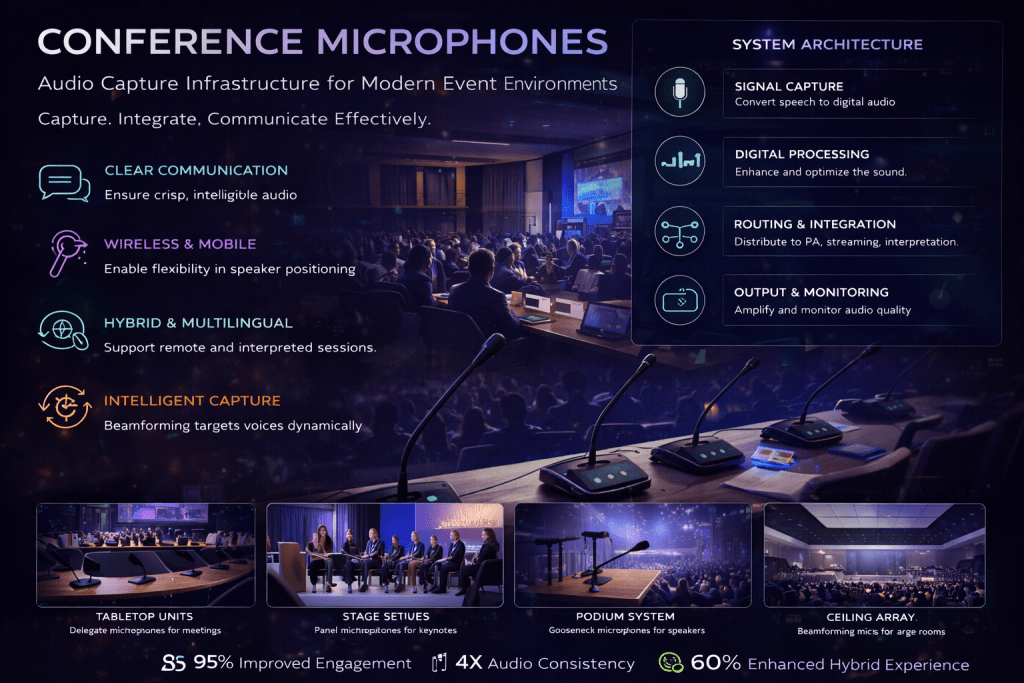
Gooseneck and Podium Microphones
Commonly used in conferences and formal presentations, these microphones provide directional pickup and are mounted on desks or podiums.
They are designed to capture a single speaker with high clarity while minimizing background noise.
Wireless Handheld and Lavalier Microphones
Wireless microphones provide mobility for speakers and panelists.
- Handheld microphones are suitable for Q&A sessions and audience participation
- Lavalier (lapel) microphones allow hands-free operation for presenters
Wireless systems require careful frequency management to avoid interference.
Boundary and Tabletop Microphones
Boundary microphones are placed on flat surfaces and capture sound from multiple directions. They are often used in panel discussions and roundtable settings.
Tabletop conference units may include:
- Integrated microphones
- Speaker outputs
- Voting or control interfaces
These are common in formal conference setups and governance events.
Ceiling and Beamforming Microphone Arrays
Advanced environments use ceiling-mounted arrays with beamforming technology.
These systems:
- Dynamically focus on active speakers
- Track movement within a space
- Reduce the need for individual microphones
Beamforming is particularly valuable in hybrid and collaborative environments.
System Architecture: From Capture to Distribution
Conference microphones operate within a broader audio system architecture.
Signal Capture and Preprocessing
Microphones convert acoustic signals into electrical signals. Preprocessing includes:
- Gain control to normalize input levels
- Noise suppression to reduce background interference
- Echo cancellation for hybrid environments
High-quality preprocessing ensures clarity before further distribution.
Digital Signal Processing (DSP)
DSP systems manage and optimize audio signals in real time.
Functions include:
- Equalization to balance frequencies
- Feedback suppression
- Automatic mixing of multiple microphone inputs
DSP is critical in environments with multiple active microphones.
Routing and Integration
Audio signals are routed to various systems:
- Public address (PA) systems for in-room amplification
- Streaming platforms for virtual attendees
- Interpretation systems for multilingual delivery
- Recording systems for archival and analytics
Integration ensures that audio is consistent across all channels.
Output and Monitoring
Monitoring systems allow operators to track audio quality in real time. This includes:
- Audio meters and diagnostics
- Headphone monitoring
- Automated alerts for anomalies
Continuous monitoring is essential for maintaining quality.
Integration with Event Technology Ecosystems
Conference microphones are deeply integrated with other event technologies.
In hybrid events, microphone feeds are synchronized with video streams to ensure alignment. In multilingual setups, audio is routed to interpretation systems for real-time translation.
Event data platforms may capture audio-related metrics, such as speaking time and participation patterns, enabling deeper analysis.
In advanced systems, microphones integrate with AI-based speech recognition for transcription, captioning, and content indexing.
Operational and Experience Impact
High-quality microphone systems directly impact attendee experience.
For in-person audiences, clear audio ensures comprehension and engagement. For virtual attendees, it is even more critical, as audio is often the primary connection to the event.
For speakers, reliable microphones provide confidence and freedom of movement. For organizers, they enable consistent delivery across sessions and formats.
From a business perspective, audio quality influences perceived professionalism and overall event success.
Technical Challenges
Conference microphone systems must address several challenges.
Acoustic environments vary widely. Large venues, reflective surfaces, and ambient noise can affect performance.
Wireless systems face spectrum congestion, particularly in large events with multiple devices.
Latency must be minimized, especially in hybrid and interpreted environments.
Scalability is another concern, as systems must handle multiple microphones and sessions simultaneously.
Future Outlook: Intelligent Audio Systems
The future of conference microphones lies in intelligent, adaptive systems.
AI-driven audio processing will enhance noise suppression, speaker identification, and automatic mixing. Beamforming technologies will become more precise, enabling seamless capture without manual configuration.
Integration with speech recognition and analytics systems will transform audio into actionable data, supporting real-time insights and post-event analysis.
As event environments become more complex, microphone systems will evolve into intelligent audio networks rather than isolated devices.
Conclusion: Capturing Clarity at the Source
Conference microphones are the نقطة البداية of the event audio pipeline. Their performance determines the quality of every downstream system—from amplification to streaming and interpretation.
In modern event technology ecosystems, they must do more than capture sound. They must integrate seamlessly, adapt to dynamic conditions, and support a wide range of use cases.
For event technology leaders, investing in advanced microphone systems is not just about audio quality—it is about enabling clear, reliable, and scalable communication across the entire event experience.

