


Introduction: The Shift from Platforms to Ecosystems
Event technology has long been dominated by all-in-one platforms promising end-to-end functionality—registration, engagement, analytics, and more within a single system. While convenient, these platforms often impose rigid workflows, limit extensibility, and create long-term dependency on a single vendor.
As event programs grow in complexity—spanning multiple formats, geographies, and audience segments—the limitations of monolithic systems become increasingly evident. Organizations require flexibility, adaptability, and the ability to evolve their technology stack without disruption.
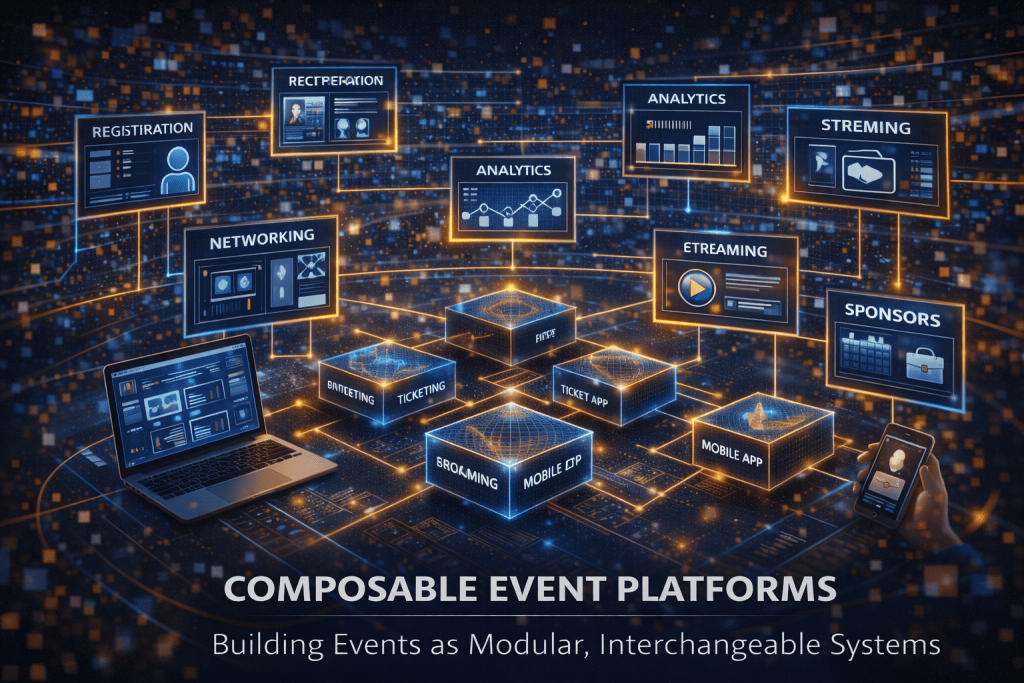
Composable event platforms address this need by rethinking event technology as an ecosystem of modular components. Instead of relying on a single platform, organizers assemble a set of interoperable services, each responsible for a specific function. These components can be combined, replaced, or extended as requirements change.
This approach aligns with broader trends in enterprise architecture, where composability enables agility and resilience in rapidly changing environments.
Defining Composability in Event Technology
Composability refers to the ability to build systems from interchangeable, loosely coupled components. In the context of event technology, this means that core functions—such as registration, ticketing, engagement, networking, and analytics—are implemented as independent services that communicate through well-defined interfaces.
Each component operates autonomously, with its own data, logic, and lifecycle. Integration occurs through APIs and event-driven mechanisms, allowing components to interact without being tightly bound to one another.
The result is a system that can be tailored to specific event requirements. Instead of adapting processes to fit a platform, organizers can design technology stacks that align with their operational and experiential goals.
Architectural Foundations
Composable event platforms are built on principles that prioritize flexibility and interoperability.
At the core is a microservices-oriented design, where each service encapsulates a specific capability. This separation enables independent development, deployment, and scaling. For example, a registration service can be updated without affecting the networking module, and analytics systems can evolve independently of engagement tools.
Event-driven architecture plays a critical role in connecting these services. Rather than relying solely on synchronous API calls, systems communicate through events—signals that represent changes in state, such as a new registration or session check-in. These events are distributed through messaging systems, allowing multiple services to respond in real time.
An API-first approach ensures that all functionality is accessible programmatically. This enables not only integration between internal components but also the inclusion of external services, expanding the ecosystem.
The Role of Integration Layers
In a composable architecture, integration is not an afterthought; it is a central concern. Middleware and orchestration layers act as the connective tissue, managing communication between services and ensuring consistency across the system.
These layers handle tasks such as data transformation, routing, and synchronization. They abstract the complexity of underlying systems, providing a unified interface for interaction. This is particularly important when integrating third-party services, which may have different data models and protocols.
A well-designed integration layer enables seamless interoperability, allowing components to be swapped or upgraded without disrupting the overall system.
Data Consistency and the Unified Model
One of the challenges of composability is maintaining data consistency across distributed services. Each component may manage its own data, leading to potential fragmentation.
To address this, composable platforms often rely on a unified data model that defines how key entities—such as attendees, sessions, and interactions—are represented. While data may be stored in different systems, it is structured in a way that ensures compatibility.
Event data platforms play a crucial role in this context, acting as a central repository for aggregated data. They provide a consistent view of the system, enabling analytics, personalization, and decision-making across components.
Experience Layer: Decoupling Frontend from Backend
In traditional platforms, user interfaces are tightly coupled with backend systems. Composable architectures decouple these layers, allowing front-end applications to be developed independently.
This separation enables greater flexibility in designing attendee experiences. Mobile apps, web portals, and on-site interfaces can be tailored to specific events or audiences without being constrained by backend limitations.
Frontend systems interact with backend services through APIs, retrieving and displaying data as needed. This approach supports rapid iteration and customization, enabling organizers to adapt experiences quickly.
Operational Advantages
The primary advantage of composable event platforms is flexibility. Organizers can select best-of-breed solutions for each function, creating a technology stack that aligns with their specific needs.
This flexibility extends to scalability. Individual components can be scaled independently based on demand. For example, streaming services can handle high traffic during key sessions, while other components operate at lower capacity.
Vendor independence is another significant benefit. Organizations are not locked into a single provider and can replace components as better solutions emerge. This reduces long-term risk and encourages innovation.
From an operational perspective, composability enables faster deployment of new features. Teams can experiment with new tools or integrations without overhauling the entire system.
Challenges and Trade-Offs
Despite its advantages, composability introduces complexity. Managing multiple services, integrations, and data flows requires careful coordination and robust governance.
Integration overhead can be significant, particularly when dealing with heterogeneous systems. Ensuring compatibility and maintaining connections across services demands ongoing effort.
There is also the challenge of system reliability. In a distributed architecture, failures in one component can impact others. Designing for resilience—through redundancy, monitoring, and failover mechanisms—is essential.
Skill requirements are higher as well. Teams must have expertise in distributed systems, API design, and integration strategies. This can be a barrier for organizations without strong technical capabilities.
Governance and Standardization
To manage complexity, composable platforms require clear governance frameworks. Standards for APIs, data models, and integration protocols must be established and enforced.
Documentation plays a critical role, ensuring that developers understand how components interact and how to integrate new services. Without proper documentation, the flexibility of composability can lead to fragmentation and inefficiency.
Monitoring and observability are also महत्वपूर्ण. With multiple components operating independently, visibility into system performance and interactions is essential for maintaining reliability.
Future Outlook: Toward Fully Composable Event Ecosystems
The evolution of composable event platforms is closely tied to broader trends in software architecture. As tools and frameworks for building and managing distributed systems mature, composability will become more accessible.
Marketplace ecosystems may emerge, where event technology providers offer modular services that can be easily integrated into existing stacks. This would enable organizers to assemble and evolve their systems with minimal friction.
Advances in orchestration and automation will further simplify management, allowing systems to adapt dynamically to changing conditions.
Conclusion: Designing for Change
Composable event platforms represent a shift from static, monolithic systems to dynamic, adaptable ecosystems. They enable organizations to build event technology stacks that evolve alongside their needs, rather than constraining them.
The transition requires a different mindset—one that embraces modularity, integration, and continuous evolution. While the challenges are non-trivial, the benefits in flexibility, scalability, and resilience are substantial.
As event technology continues to advance, composability will play a central role in enabling innovation and delivering more sophisticated, responsive experiences.