


Audio mixers are essential in both live sound and studio environments, enabling audio engineers to manage multiple audio sources, combine signals, and adjust the levels, dynamics, and equalization to create a coherent and balanced output. The understanding of signal flow and routing within an audio mixer is crucial to optimizing sound quality and ensuring a smooth workflow.
This article explores audio mixer signal flow and routing mechanisms, diving deep into the components, path, and techniques used to handle audio signals efficiently.
Audio Mixers are devices that allow the combination of multiple audio signals into a single or multiple output signals. They are widely used in recording studios, live sound reinforcement, broadcast, and post-production. The primary functions of an audio mixer include:
- Combining signals from different sources (microphones, instruments, playback devices).
- Adjusting the level (volume) of each signal.
- Shaping the sound through equalization (EQ) and dynamic processing.
- Routing the audio signals to various outputs (main outputs, monitors, auxiliary sends).
Understanding Signal Flow in Audio Mixers
Signal flow refers to the path an audio signal takes from its source, through the various stages of an audio mixer, to its final destination (output). Understanding the signal flow is fundamental for audio engineers to manage sound effectively, troubleshoot problems, and set up an efficient audio mixing process.
Basic Signal Flow Path:
- Input Stage: The audio signal enters the mixer through various inputs (XLR, TRS, RCA, etc.).
- Gain Stage: The initial pre-amplification of the signal to bring it up to an operational level.
- Equalization (EQ) Stage: The signal passes through the EQ section where frequencies can be adjusted.
- Auxiliary Sends: Routing of the signal to additional outputs for effects processing or monitoring.
- Pan Control: Distribution of the signal across the stereo field (left and right).
- Fader Control: Adjustment of the signal level for balancing in the mix.
- Output Stage: The signal is sent to the final output destinations such as main outputs, subgroup outputs, or monitor outputs.

Components of Signal Flow in Audio Mixers
- Input Channels: Each input channel consists of several components: input connectors, gain controls, equalization, auxiliary sends, pan controls, and faders. These components work in tandem to shape the signal as it progresses through the mixer.
- Gain Controls (Trim/Preamplifier): Adjusts the input signal level to ensure optimal signal-to-noise ratio and prevents distortion.
- Equalizers (EQ): Allows the adjustment of specific frequency ranges (low, mid, high) to shape the tonal balance of the signal.
- Auxiliary Sends: Provides additional routing paths for the signal, commonly used for effects (like reverb and delay) or for creating separate monitor mixes.
- Pan Pots: Used to position the audio signal within the stereo field.
- Faders: Control the final level of the signal sent to the output stage.


Routing Mechanisms in Audio Mixers
Routing refers to the process of directing audio signals to various destinations within or outside the mixer. Different routing mechanisms are used depending on the application and the type of mixer (analog or digital).
- Direct Outputs: Route the signal from individual channels directly to external devices, such as recorders or processors, bypassing the main mix bus.
- Buses: Pathways that carry signals from multiple channels to a single output or processing point. Common types include:
- Main Mix Bus: The master output to which all channels are routed for the final mix.
- Subgroups: Intermediate buses that allow grouping of channels for collective processing or level control.
- Auxiliary Buses (Aux Buses): Additional buses used for effects, monitoring, or routing to external devices.
- Matrix Mixing: A feature in some audio mixers that allows for custom routing and mixing of multiple input signals to different output configurations.
Types of Audio Mixers and Signal Routing
There are several types of audio mixers, each with unique signal flow and routing capabilities. Choosing the right audio mixer depends on how well you understand signal routing.:
- Analog Mixers: Use physical components to route and process signals. Analog mixers provide a tactile interface, often favored for their simplicity and natural sound.
- Digital Mixers: Use digital signal processing (DSP) to handle audio signals, offering extensive routing flexibility, onboard effects, and recallable settings.
- Hybrid Mixers: Combine analog signal handling with digital routing and effects, providing a balance of analog warmth and digital flexibility.
Detailed Signal Flow Diagram
A visual representation of signal flow in audio mixers helps illustrate how signals are routed and processed. Here is a simplified table of the signal path in a typical analog audio mixer:
| Component | Function | Signal Path |
| Input Connectors | Receives audio signal from microphones/instruments | Source to Mixer Input |
| Gain Control (Preamp) | Amplifies signals to an optimal level | Input Stage |
| Equalizer (EQ) | Adjusts frequency balance | Post-Gain Control |
| Auxiliary Sends | Sends signal to effects/monitoring channels | Post-EQ |
| Pan-Pot | Positions signal in the stereo field | Post-Auxiliary Sends |
| Fader | Controls signal level in the main mix | Post-Pan Pot |
| Main Output Bus | Combines signals for output | Post-Fader |
| Direct Outputs | Sends signal directly to external devices | Channel Output to External Device |
| Subgroup Outputs | Group channels for collective control/output | Pre-Main Output |
| Auxiliary Bus | Creates custom mixes for effects or monitoring | Post-Fader |
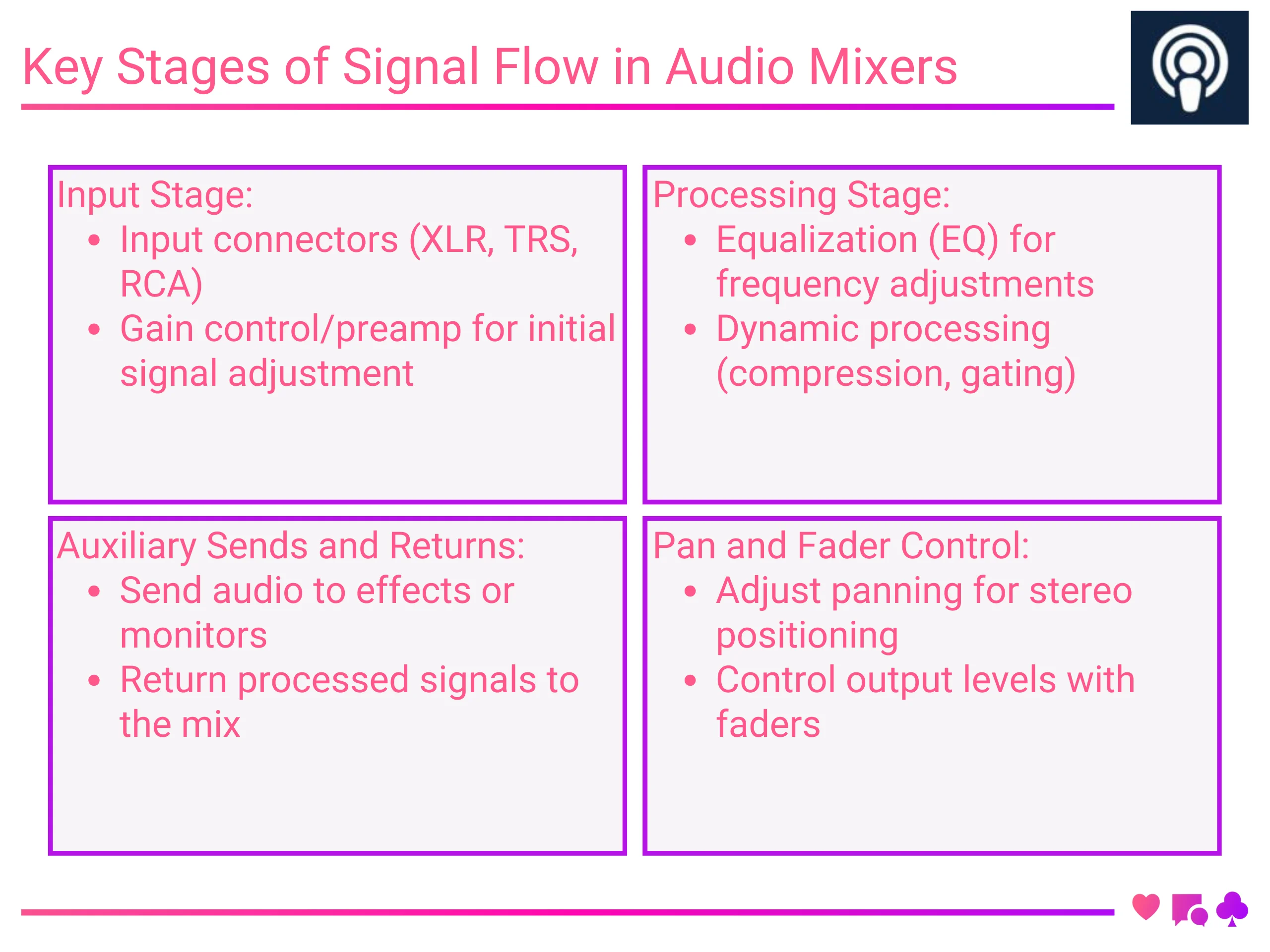
Key Stages of Signal Flow in Audio Mixers
- Input Stage:
- Input connectors (XLR, TRS, RCA)
- Gain control/preamp for initial signal adjustment
- Processing Stage:
- Equalization (EQ) for frequency adjustments
- Dynamic processing (compression, gating)
- Auxiliary Sends and Returns:
- Send audio to effects or monitors
- Return processed signals to the mix
- Pan and Fader Control:
- Adjust panning for stereo positioning
- Control output levels with faders
- Output Stage:
- Route signals to main outputs, subgroups, or direct outputs
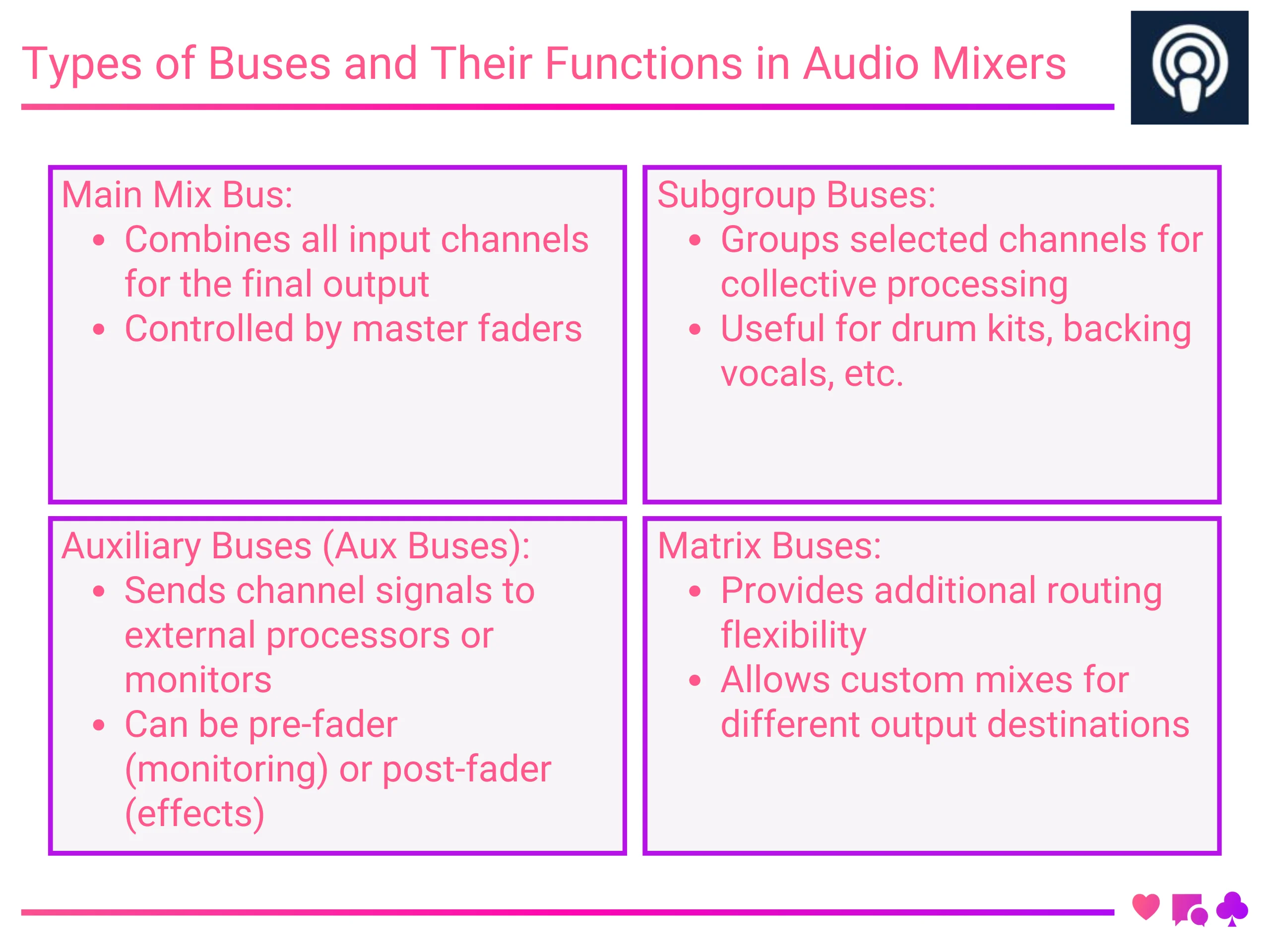
Types of Buses and Their Functions in Audio Mixers
- Main Mix Bus:
- Combines all input channels for the final output
- Controlled by master faders
- Subgroup Buses:
- Groups selected channels for collective processing
- Useful for drum kits, backing vocals, etc.
- Auxiliary Buses (Aux Buses):
- Sends channel signals to external processors or monitors
- Can be pre-fader (monitoring) or post-fader (effects)
- Matrix Buses:
- Provides additional routing flexibility
- Allows custom mixes for different output destinations
- Direct Outputs:
- Sends individual channel signals to external devices
- Ideal for multi-track recording setups
Signal Flow in Digital Mixers
Digital mixers introduce new complexities in signal flow with their DSP capabilities and advanced routing options. Integrating audio mixers with DAWs can streamline your signal flow for digital studios. Here are some of the critical aspects of signal flow in digital mixers:
- Layer-Based Routing: Digital mixers often use multiple layers to handle a large number of inputs and outputs without requiring a vast physical footprint.
- Virtual Patching: Unlike analog mixers, digital mixers use software to route signals, allowing for more flexible and complex routing configurations. Consider wireless audio mixer systems if you want fewer cables and more flexibility in routing.
- Onboard Effects Processing: Digital mixers often have built-in effects such as reverb, delay, and compression, which can be inserted into the signal path without requiring external processors.
- Recallable Scenes and Settings: Digital mixers can save and recall specific signal flow configurations, which is particularly useful in live sound environments.

Advanced Routing Techniques
- Parallel Processing: Involves duplicating a signal path and processing each duplicate differently. Commonly used in dynamic processing to preserve the original signal’s transients while adding compression.
- Sidechain Routing: Uses the signal from one channel to control a processor on another channel, such as ducking background music when a microphone is active.
- Multiband Routing: Splits a signal into different frequency bands for individual processing before recombining them, used in mastering or advanced sound design.

Audio Mixer Signal Flow and Routing Summary
Understanding the intricacies of audio mixer signal flow and routing is vital for anyone involved in sound production or live sound reinforcement. Whether using an analog, digital, or hybrid mixer, knowing how to manage signal paths effectively ensures a clean, balanced, and optimized audio output. Sound engineers can achieve high-quality results in various applications with the right routing techniques and a comprehensive grasp of signal flow.
By grasping the concepts covered in this article, audio professionals can better navigate the complexities of audio mixing, ensuring that their mixes are both technically sound and creatively satisfying. Don’t forget that the right audio mixer accessories and add-ons can enhance signal quality.
Academic Reference For Audio Mixer Signal Flow and Routing
- Software-defined radio for modular audio mixers: Making use of market-available audio consoles and software-defined radio to build multiparty audio–mixing systems
- Signal Flow Training with Virtual Simulations as a Co-Curricular Tool
- Design Issues for Digital Audio Networks
- Software-based video–audio production mixer via an IP network
- Digital audio mixing
- Mixers
- [PDF] Distributed Audio Mixing Network (DAMN)
- [PDF] Audio mixers for centralized VoIP conferencing
- Mixer architectures
- An active router architecture for multicast video distribution